The DIY Investment Trap: Why New Zealanders Need to Play the Net Game

The democratisation of investing has transformed the financial landscape. Where once only institutional investors had access to sophisticated investment vehicles, today's retail investors can build diversified portfolios with a few clicks on their smartphones. Exchange-traded funds (ETFs) have been at the forefront of this revolution: in the United States, they now represent half of all listed funds[1], a remarkable shift that reflects their popularity and accessibility. 

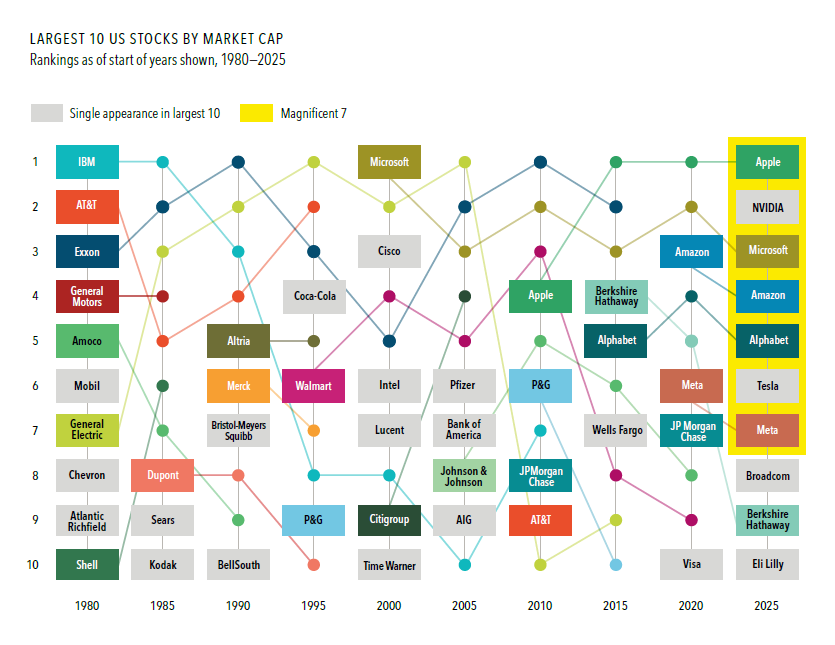
The investment supermarket has expanded exponentially, offering strategies across listed and unlisted assets, domestic and international markets, and countless sectors and themes. From tech giants like Apple and Nvidia to broad market indices, bond funds to commodity trackers, the barriers to entry have never been lower.  

A generation ago, building a globally diversified portfolio required significant wealth and professional intermediaries. Today, it requires a brokerage account and an internet connection. 

But more choice doesn't automatically mean better outcomes. In New Zealand, there's a growing cohort of DIY investors who are playing the gross game when they should be playing the net game. They're watching their portfolio balances grow, celebrating double-digit returns, and comparing performance with friends… all whilst ignoring the substantial tax implications that will ultimately determine their real wealth accumulation. 

The Bracket Creep Reality 

New Zealand's tax landscape has shifted dramatically, yet many investors haven't adjusted their thinking accordingly. A significant number of Kiwis now find themselves in the 33% tax bracket (income between $70,000 and $180,000) or even the 39% bracket for those earning over $180,000, often without realising it until after 31 March when their tax returns are typically filed.[2] 

This isn't always due to massive salary increases or career progression. Bracket creep, driven by wage inflation without corresponding tax threshold adjustments, is quietly pushing more New Zealanders into higher tax brackets each year[3]. As wages rise to keep pace with the cost of living, the tax system captures an increasingly large slice of that income. What once seemed like a tax bracket reserved for high earners has become surprisingly accessible to middle-income professionals. 

But there's another factor many overlook when calculating their tax position: total earnings extend far beyond salary. Consider the full picture of your financial life. That cash sitting in the bank, even at relatively low interest rates, generates taxable income[4]. It might not seem like much on an individual transaction basis, but across multiple accounts and a full tax year, it adds up. 

Trust distributions, company dividends, rental income from investment properties, and profits from share trading; these all contribute to your taxable income.  

Many investors are genuinely surprised when they discover their effective tax rate is higher than anticipated, simply because they've been thinking about salary in isolation rather than total taxable income.  

The Hidden Consequence 

When you buy shares in Nvidia, Apple, or any other direct shareholding, or when you invest in ETFs tracking international markets, you're creating taxable events. Under New Zealand's tax rules, particularly the Foreign Investment Fund (FIF) regime, these investments generate tax obligations that must be included in your annual return[5]. 

The FIF rules are complex and often misunderstood. Many investors assume they only pay tax when they sell. In reality, they may be liable for tax on deemed income each year, regardless of whether they've sold anything. Yet a startling number of investors either don't realise this or don't adequately account for it in their investment strategy. 

They're focused on gross returns (the headline numbers showing how much their portfolio has grown) without applying a tax overlay to understand their true, net position. They celebrate when their tech stock portfolio rises 25%, but forget to calculate what that means after tax obligations are met. 

How We Got Here 

For roughly 25 years, New Zealand maintained a relatively flat tax structure with a top rate of 33%[6]. The tax environment was stable and predictable. Investors could make reasonably informed decisions knowing that their tax position would remain relatively constant. 

But the introduction of the 39% top tax rate in 2021[7], combined with the absence of inflation indexing for tax brackets, has fundamentally changed the game. Each year, more New Zealanders cross into higher tax brackets not because they're genuinely wealthier in real terms, but simply because thresholds haven't kept pace with inflation. 

The compounding effect is significant. A professional who was comfortably in the 30% bracket (or lower) a decade ago might now find themselves in the 33% or even 39% bracket, despite their real purchasing power having barely changed. The tax burden has increased substantially, yet investment strategies have often remained unchanged. 

Gross Returns vs Net Reality 

An investment delivering a 10% gross return might sound attractive, but if you're in the 39% tax bracket and a significant portion of that return is taxable under the FIF rules, your net return tells a very different story. Suddenly that 10% might be closer to 6% or 7% after tax. It’s still positive, but materially different from the headline figure. 

This distinction becomes even more critical when comparing investment options. A lower-gross-return investment with tax advantages might deliver superior after-tax returns compared to a higher-gross-return investment that's tax-inefficient for your circumstances. 

You don't want to win the battle only to lose the war. Chasing gross returns without understanding the net outcome is a pyrrhic victory – it looks impressive on portfolio statements but delivers disappointing real-world results when tax time arrives. 

The Silo Trap 

Even when investors recognise the need for professional advice, they can fall into another trap: the silo regime. Perhaps influenced by barbecue conversation about diversifying across advisers – “don't put all your eggs in one basket, mate” – some investors split their portfolio. They might allocate $750,000 here with one adviser, another substantial chunk there with a second, and perhaps a third portion elsewhere for good measure. 

The logic seems sound on the surface. After all, diversification is a fundamental investment principle, so why not diversify your advisers too? It provides a sense of security, multiple perspectives, and perhaps even keeps each adviser "honest" through implicit competition. 

You’re essentially asking each adviser to play with one hand tied behind their back. 

No single adviser in this fragmented arrangement understands your complete tax position. They can't see the full picture of your income sources, your various investment vehicles, or how different components of your portfolio interact from a tax perspective. They're optimising for their slice of your wealth without any visibility into the whole. 

One might be selecting investments that generate substantial taxable income, unaware that another adviser is doing the same thing, pushing you into a higher tax bracket than necessary. Or they might be duplicating strategies, eliminating the diversification benefits you sought by splitting your portfolio in the first place. 

Each adviser might be doing an excellent job with their portion, yet your overall outcome remains suboptimal because no one is orchestrating the tax efficiency of the complete picture[9].  

It's the financial equivalent of having multiple chefs each cooking one course of a meal without coordinating the menu. You might end up with three excellent dishes that don't work together at all. 

Why You Need a Financial Adviser 

Professional guidance matters. And not just any adviser, but one who can see your complete financial picture and implement a coordinated, tax-efficient strategy across all your assets. 

Investment success isn't measured by individual account performance. It's measured by your actual, after-tax wealth accumulation. An adviser with a holistic view can structure investments in ways that are tax-efficient for your specific circumstances, recognising that different investment vehicles have different tax treatments and that your personal tax situation is unique. 

They can help you understand whether PIE funds, direct shares, or other investment structures make the most sense for your position. They can coordinate the timing of income recognition, manage your exposure to FIF rules, and ensure your overall portfolio is working towards your net wealth goals rather than simply chasing gross returns. 

When seeking advice, look for a fee-only, unconflicted fiduciary adviser[10]. This ensures their recommendations are driven by your best interests, not commission structures or product sales targets. A fiduciary is legally obligated to put your interests first—a distinction that matters profoundly when navigating the complex intersection of investment strategy and tax planning. 

Fee-only advisers are compensated for their advice and service, not for selling particular products. This alignment of interests is crucial when you need objective guidance on tax-efficient structuring rather than a sales pitch for the highest-commission product. 

The Path Forward 

The DIY investment revolution isn't going away, nor should it. Access to investment opportunities is fundamentally democratising and positive. But as the New Zealand tax environment becomes increasingly complex, investors need to evolve their approach. 

Understanding your total tax position, applying a tax overlay to investment decisions, and focusing relentlessly on net returns rather than gross figures—these aren't optional luxuries. They're necessities for anyone serious about building wealth in today's environment. 

The supermarket aisle may be longer than ever, offering more choice than any previous generation of investors could have imagined. But choosing wisely requires understanding the true price you're paying; not just the label on the shelf, but the price after tax.  

The game has changed. Make sure you're playing it properly. 

Nick Stewart

(Ngāi Tahu, Ngāti Huirapa, Ngāti Māmoe, Ngāti Waitaha)

Financial Adviser and CEO at Stewart Group

  • Stewart Group is a Hawke's Bay and Wellington based CEFEX & BCorp certified financial planning and advisory firm providing personal fiduciary services, Wealth Management, Risk Insurance & KiwiSaver scheme solutions.

  • The information provided, or any opinions expressed in this article, are of a general nature only and should not be construed or relied on as a recommendation to invest in a financial product or class of financial products. You should seek financial advice specific to your circumstances from a Financial Adviser before making any financial decisions. A disclosure statement can be obtained free of charge by calling 0800 878 961 or visit our website, www.stewartgroup.co.nz

  • Article no. 444


References

[1] Investment Company Institute, 2024 data on US ETF market share  

[2] Inland Revenue Department, "Individual income tax rates" (current as of 2024-25 tax year)  

[3] New Zealand Treasury, "Fiscal drag and bracket creep analysis," 2024  

[4] Inland Revenue Department, "Resident withholding tax on interest"  

[5] Inland Revenue Department, "Foreign investment fund rules and portfolio investment entities"  

[6] New Zealand Tax History, "Top personal tax rates 1988-2021"  

[7] Taxation (Annual Rates for 2020–21, Feasibility Expenditure, and Remedial Matters) Act 2021  

[8] Financial Advice New Zealand, "The importance of holistic financial planning," professional standards guidance  

[9] Chartered Accountants Australia and New Zealand, "Tax-effective wealth management strategies," 2024

[10] Financial Markets Authority, "Financial adviser disclosure requirements and fiduciary standards," Financial Markets Conduct Act 2013 

Full and Final: The Value of Moving Forward

With Waitangi Day upon us, it’s the perfect opportunity to reflect on what makes us unique. We're one of few nations built on a founding document promising partnership: the Treaty has been imperfectly honoured, fiercely contested, never abandoned… and the journey has taught us something valuable about moving forward without forgetting the past.

There's a story from Ngāi Tahu history that captures this lesson. It involves a sacred dogskin cloak, a violation of tapu, and a cost compounded beyond anyone's imagination.

Arowhenua Marae - Photo by Nick Stewart

The Cost of Feuds

Around 1826, while Chief Te Maiharanui was away, a woman from Waikākahi wore the kurīawarua – the Chief's sacred dogskin cloak. This act sparked the kai huānga feud: years of fighting between kin across Banks Peninsula, where the final insult to the enemy after battle was to consume them (kai huānga meaning ‘to eat a relative’, as the fighting was between hapū).[1]

This internal warfare weakened Ngāi Tahu at a crucial moment in time. Te Rauparaha of Ngāti Toa then swept down from Kapiti Coast with muskets. He found an iwi divided. The feud ended when the external threat loomed, but the damage had been done: the siege of Kaiapoi and the fall of Ōnawe found Ngāi Tahu already vulnerable because of the previous fighting.

The cloak was never worth what it ultimately cost.

The Next Fight: Te Kerēme

Ngāi Tahu learned from this. When the land was taken – eight million hectares purchased by the Crown for £2,000 through Kemp's Deed in 1848 – Ngāi Tahu made its first claim against the Crown in 1849, just one year after the deed was signed.[2]

For 149 years, generation after generation carried the fight forward. This became known as Te Kerēme (The Claim).

Above the Arowhenua Marae in Temuka, where tribal gatherings have been held for over a century, hangs the name Te Hapa o Niu Tireni: "The Broken Promises of New Zealand."[3] That name captures the weight of grievance the iwi carried, which were many and justified.

  • The Crown had promised reserves for Ngai Tahu of approximately ten percent of the land sold, along with schools and hospitals. None materialised.

  • Access to mahinga kai – traditional food gathering places – was lost.

  • Sacred sites and urupā were alienated.

  • By the early 1900s, fewer than 2,000 Ngāi Tahu remained alive in their own land, deprived of virtually everything required to survive beyond subsistence level.

The fight for justice took many forms. In 1877, the prophet Hipa Te Maiharoa led over 100 followers to Te Ao Mārama in the upper Waitaki – land he maintained had never been legitimately sold under Kemp's Deed. For two years they cultivated kai and taught tikanga, a peaceful assertion of rights that had been ignored.[4] When the armed constabulary came in 1879, Te Maiharoa chose not to shed blood. They left peacefully. Though he died before any resolution, his example of principled, persistent resistance without self-destruction gave strength to the generations who continued the fight.

The struggle continued through courts, commissions, and countless petitions. When Ngāi Tahu first took Te Kerēme to court in 1868, the government passed laws to prevent the courts from hearing it. A Commission of Inquiry a decade later had its funding halted by the Crown mid-investigation. In 1887, Royal Commissioner Judge MacKay acknowledged only a "substantial endowment" of land would begin to right so many years of neglect. By 1991, at least a dozen different commissions, inquiries, courts and tribunals had repeatedly established the veracity and justice of Te Kerēme.

Fast forward to 1998. Ngāi Tahu became the first iwi to settle with the Crown under the modern Treaty settlement process. The settlement was cents on the dollar – everyone knew it. The breach had been egregious, the losses enormous. By any measure, they deserved more.

But Ngāi Tahu took the deal anyway. Full and final. As Tā Mark Solomon reflected: "The Crown reckoned full redress was worth $12 to $15 billion. Our advisers thought closer to $20 billion. We settled for $170 million — a lot less, but it allowed Ngāi Tahu to move forward, to rebuild."[5]

The Rule of 72: Investing in the future

Why settle for less than one percent of what was owed? The Rule of 72 provides part of the answer. At 7.2% returns, money doubles every 10 years. That $170 million settlement has grown to $1.66 billion in net assets today - nearly a tenfold increase in 27 years.[6] But it required stopping the fight and starting to invest.

The opportunity cost of delay is staggering. Every year spent fighting is a year money isn't compounding. Every year locked in grievance mode is a year not building for the future. The settlement allowed Ngāi Tahu to shift from survival mode to growth mode, from defending what was left to creating what could be.

This principle extends far beyond Treaty settlements:

  • Family disputes over estates burn tens of thousands in legal fees while the assets stagnate or depreciate.

  • Former business partners spend more on lawyers than the company was ever worth.

  • Divorce battles consume resources that could be rebuilding two separate lives.

 We hang in there because the principle matters, we deserve more, and because justice demands it.

And principle does matter. Justice is real – but so is your future. So is your peace of mind. So is the life you could be building instead of the grievance you're nursing.

Sometimes the juice isn't worth the squeeze.

The Value in Moving Forward

Holding grievances costs your mental health, your wellbeing, your ability to move forward – not to mention the fiscal cost. The human mind has limited bandwidth. Energy spent on past wrongs is energy unavailable for future opportunities. Anger may be righteous, but it's still corrosive.

You can be right, and still be trapped in a bad situation.

The settlement let Ngāi Tahu stop fighting the past (justified though they were) and start creating the future. That psychological shift may be worth more than any dollar figure – but the dollars did add up as well. Within a generation, the iwi went from near-extinction to becoming one of New Zealand's major economic and cultural forces. The asset base grew, yes, but so did everything else: language revitalisation programs, educational scholarships, marae restoration, cultural renaissance.

Modern New Zealand is a nation where nearly one in three people are first generation migrants, with fresh eyes unburdened by our nation’s history. These newcomers don't carry the weight of Te Hapa o Niu Tireni – the broken promises – and perhaps that lightness allows different possibilities.

That’s not to say we should forget. The name still hangs above Arowhenua Marae. The history is taught, remembered, and honoured. Moving on doesn't mean sweeping things under a rug and forgetting they existed. It means choosing where to invest your finite resources: backward into grievance, or forward into growth.

This Waitangi weekend, we celebrate a nation learning to move forward together, imperfectly but persistently. The dogskin cloak is long gone, but the lessons remain.

Sometimes "full and final" is the smartest decision you'll make. Not because you got everything you deserved, or because justice was fully served – but because opportunity cost exceeds what most people imagine.

In investment, and in life, the math is unforgiving. Every year looking backward is a year not compounding forward.

That's the real lesson Ngāi Tahu learned, twice over. Once the very hard way, fighting themselves while enemies approached, and once by choice: taking less than they deserved, and turning it into more than anyone expected.

The question isn't whether your grievance is justified. It probably is. The question must instead become: what's it costing you to hold on? And what could you build if you let it go?

Nick Stewart

(Ngāi Tahu, Ngāti Huirapa, Ngāti Māmoe, Ngāti Waitaha)

Financial Adviser and CEO at Stewart Group

  • Stewart Group is a Hawke's Bay and Wellington based CEFEX & BCorp certified financial planning and advisory firm providing personal fiduciary services, Wealth Management, Risk Insurance & KiwiSaver scheme solutions.

  • The information provided, or any opinions expressed in this article, are of a general nature only and should not be construed or relied on as a recommendation to invest in a financial product or class of financial products. You should seek financial advice specific to your circumstances from a Financial Adviser before making any financial decisions. A disclosure statement can be obtained free of charge by calling 0800 878 961 or visit our website, www.stewartgroup.co.nz

  • Article no. 443


References

[1] Mikaere, B. (1988). Te Maiharoa and the Promised Land. Auckland: Heinemann.

[2] Te Rūnanga o Ngāi Tahu. (n.d.). Claim History. Retrieved from https://ngaitahu.iwi.nz/ngai-tahu/creation-stories/the-settlement/claim-history/

[3] Arowhenua Marae. (n.d.). Te Hapa o Niu Tireni - The Broken Promises of New Zealand. Temuka, South Canterbury.

[4] Mikaere, B. (1988). Te Maiharoa and the Promised Land. Auckland: Heinemann.

[5] Solomon, M. with Revington, M. (2021). Mana Whakatipu: Ngāi Tahu Leader Mark Solomon on Leadership and Life. Massey University Press.

[6] Te Rūnanga o Ngāi Tahu. (2024). Annual Report 2024. Retrieved from https://ngaitahu.iwi.nz

28 Investment Principles That Actually Work When Markets Don't Cooperate

I've watched families navigate decades of volatility: crashes, recoveries, euphoria, panic. The ones who preserve wealth across generations don't have secret information or perfect timing. They follow simple rules, consistently.

February has 28 days. To ring it in, here are 28 guiding principles that have stood the test of time regardless of market activity.

1.       The market rewards patience, not prediction.

Most noise isn't information. The constant stream of commentary, analysis, and breaking news creates the illusion that staying informed means staying ahead. It doesn't. The market moves on fundamentals that reveal themselves slowly, not on headlines that change hourly.

2.       Focus on what you can control: Costs, discipline, diversification, behaviour.

You cannot control returns. You cannot control when recessions arrive or when bull markets end. But you can control how much you pay in fees, how consistently you invest, how broadly you spread your risk, and how you respond when fear or greed takes hold.

3.       You don't need to beat the market. You just need to capture it.

The obsession with outperformance drives investors towards complexity, higher costs, and ultimately, disappointment. Capturing market returns through low-cost, diversified portfolios has built more wealth over time than the pursuit of alpha ever has.

4.       The simplest portfolio is often the smartest.

Complexity rarely adds value. It adds cost, confusion, and opportunity for error. A straightforward allocation across global equities and bonds, rebalanced systematically, has outperformed the vast majority of elaborate strategies.

5.       Volatility is the price of admission.

Don't demand returns without accepting the ride. Equities deliver premium returns over time, because of fluctuations in the short term. If you cannot stomach the volatility, you don't deserve the returns.

6.       Time in the market matters more than timing the market. Always.

Missing just the 10 best days over a 20-year period can cut your returns nearly in half. Funnily enough, the best days often follow the worst ones – so it’s hard to capture them after getting cold feet on the downswing. Staying invested through the chaos is what separates wealth-builders from market-timers.

7.       Diversification is a dark horse.

Its power is revealed over decades, not days. When one asset class stumbles, another steadies the ship. The benefit isn't dramatic in any one year, but over a lifetime of investing, it's the difference between weathering storms and being swept away by them.

8.       Your plan should be built on evidence, not emotion.

Especially when emotions run high. When markets crash, fear whispers that this time is different and worse than any before. When markets soar, greed tells you that you're missing out. Evidence and decades of market history tell a different story – a much more trustworthy one.

9.       Chasing performance is a tax on impatience.

Last year's winners become this year's laggards with predictable regularity. By the time a fund or strategy appears on a "best performer" list, the opportunity has usually passed. Avoid getting swept up in the furore.

10.  The market has already priced in what everyone knows.

You don't need to outguess it. If information is public, it's already reflected in prices. Your edge as an investor isn't superior information, it's superior behaviour.

11.  A disciplined strategy beats a brilliant prediction. Every time.

Predictions fail. Discipline endures. The investor who follows a consistent plan through all market conditions will outperform the ‘strategist’ who tries to predict turning points.

12.  Your behaviour matters more than your products.

Panic is more expensive than fees: selling in a downturn locks in losses, while buying at market peaks locks in mediocre returns. Managing your behaviour by staying calm, and staying invested, matters far more than optimising your expense ratio by a few measley basis points.

13.  You don't need the perfect moment.

The moment you start is perfect enough. Markets climb over time. Waiting for a correction before investing often means waiting forever. Start now. Adjust as you go.

14.  Rebalancing is the quiet hero of long-term returns.

It forces buy-low, sell-high. When equities surge, rebalancing trims them back. When they crash, rebalancing buys more. It's counter-intuitive, uncomfortable… and extraordinarily effective over time.

15.  The best portfolios feel boring.

Boredom is not a bug, it's a feature. If your portfolio keeps you up at night with excitement, you’re probably taking on unnecessary risk. Wealth is built slowly, quietly, and without drama.

16.  Markets recover more often than they collapse.

History is your friend. Every bear market in history has eventually given way to a new bull market. Crashes feel permanent in the moment. They never are – as the adage goes, “this too shall pass.”

17.  Ignore headlines.

They're written to sell attention, not build wealth. Financial media thrives on urgency and alarm. Your portfolio should thrive on patience and perspective.

18.  Compounding works best when you don't interrupt it.

Let time do the heavy lifting. Albert Einstein allegedly called compound interest the eighth wonder of the world. But, it only works if you leave it alone – every time you exit the market, you reset the clock.

19.  Costs compound too.

Costs compound just like returns. Pay for advice that adds value, not for products that don't. The difference between value and waste always reveals itself in the fullness of time.

20.  Bad days don't destroy portfolios. Bad decisions do.

Markets fall. That's normal, and things will swing back the other way. Selling during the fall, abandoning your plan, or fleeing to cash – those are the decisions that inflict permanent damage.

21.  Not every risk deserves a reward.

Factor premiums do. Stocks are riskier than bonds, so they should deliver higher returns. Small-cap and value stocks have historically outperformed over long periods. These are risks worth taking. Concentrated bets on individual stocks or sectors? Not so much.

22.  Your portfolio should be built around you, not around the news cycle.

Your goals, your time horizon, and your risk tolerance should dictate your allocation. Not the latest economic forecast or geopolitical crisis.

23.  You don't need to predict the future.

…But you do need a strategy that survives it. Robust portfolios aren't built on forecasts. They're built on diversification, discipline, and the recognition that uncertainty is permanent.

24.  Stay invested, stay diversified, stay disciplined.

The rest is commentary. If you do these three things consistently, you will be fine. Better than fine, in fact. You'll be wealthier than the vast majority of investors who spend their lives chasing the next opportunity.

25.  Wealth isn't created in moments of excitement.

It's created in years of consistency. The investors who succeed aren't the ones who make brilliant trades or perfectly time the market. They're the ones who show up, year after year, regardless of conditions. Consistency compounds.

26.  Your worst investing day feels catastrophic. Your best investing decade feels inevitable.

Perspective matters. In the moment, a 20% drawdown feels like the end. Twenty years later, it's a footnote. Keep the long view. Stay the course.

27.  Successful investors are more patient than ‘smart’.

Intelligence helps, but temperament wins out every time. The ability to sit still, to do nothing when everyone else is panicking or euphoric, is worth more than any financial qualification.

28.  Markets don't care about your timeline. Build a plan that doesn't care about the markets.

You might need money in five years for a house deposit or in thirty years for retirement. The market will do what it does regardless. Structure your portfolio around your needs, not market predictions, and you'll sleep better through every cycle.

Remember: Markets will always be chaotic. Your response doesn't have to be.

Follow the rules (and seek professional advice)

These principles work. But they work best when you have someone in your corner who isn't conflicted by commissions, product sales, or institutional agendas.

Seek independent, impartial advice that puts you first and foremost. You are the sun, not the moon: your financial plan should orbit around you, your goals, your circumstances. Not around what someone else needs to sell.

Nick Stewart

(Ngāi Tahu, Ngāti Huirapa, Ngāti Māmoe, Ngāti Waitaha)

Financial Adviser and CEO at Stewart Group

  • Stewart Group is a Hawke's Bay and Wellington based CEFEX & BCorp certified financial planning and advisory firm providing personal fiduciary services, Wealth Management, Risk Insurance & KiwiSaver scheme solutions.

  • The information provided, or any opinions expressed in this article, are of a general nature only and should not be construed or relied on as a recommendation to invest in a financial product or class of financial products. You should seek financial advice specific to your circumstances from a Financial Adviser before making any financial decisions. A disclosure statement can be obtained free of charge by calling 0800 878 961 or visit our website, www.stewartgroup.co.nz

  • Article no. 442


The People's Poet and The People's Purse: From Burns to KiwiSaver

"A man's a man for a' that." - Robert Burns, 1795 [1]

Nigh on Burns Day feels like an appropriate moment to reflect on Scotland's most beloved poet. Robert Burns was no mere wordsmith; he was a revolutionary who believed wisdom and dignity belonged to everyone, not just the privileged few. Writing in Scots dialect rather than formal English, he made poetry accessible to common people in the 1700s; a radical and transformative act in its time.

Burns lived during the Age of Enlightenment, when intellectual discourse was largely confined to universities and aristocratic salons. Yet here was a ploughman-poet who insisted profound insights could come from anywhere: the farm, the tavern, ordinary folk going about their daily lives. His poetry gave voice to universal human experiences in language the people could understand.

An 18th-century Scottish poet has more to do with modern finance than you might think. Burns' commitment to democratising culture mirrors a shift that's been happening in the investment world, culminating in what might be New Zealand's most egalitarian financial innovation: KiwiSaver.

Burns' Revolutionary Accessibility

When Burns penned verses celebrating ploughmen, mice, and haggis, he was doing something deeply subversive. He was adamant that insight into the human condition – love, loss, joy, struggle – wasn't the exclusive domain of the educated elite. His genius lay in understanding that emotional intelligence and wisdom about human nature mattered more than formal education or social standing.

Consider "Auld Lang Syne," sung around the world each New Year; a meditation on friendship and memory, accessible to anyone. Or "To a Mouse," where disturbing a field mouse's nest becomes a profound reflection on planning and uncertainty. These weren't lofty academic exercises but observations from lived experience.

Burns recognised that a farmer could possess a deeper understanding than a nobleman. He celebrated the common person through genuine respect for their capacity for wisdom and feeling. This wasn't sentimentality; it was a fundamental belief in human equality that was genuinely radical for his era.

The Long Road to Investment Democratisation

For most of human history, investing was an aristocratic pursuit. You needed significant capital, insider connections, and often formal education to participate. Even in more recent history, the average person's financial planning extended to perhaps a savings account and hoping their employer's pension would suffice.

The journey toward broader access has been gradual:

  • Stock exchanges initially served merchants and wealthy traders.

  • The 20th century brought mutual funds and pension schemes, but these remained largely employer-controlled or required significant individual initiative and financial literacy.

  • The democratisation of investment accelerated with regulatory changes, technology, index funds, and online platforms.

Yet each advance still required knowledge and a confidence many New Zealanders lacked. We had democratised access… but barriers to participation remained.

KiwiSaver: The People's Purse

Enter KiwiSaver in 2007 – New Zealand's fiscal equivalent to Burns’ poetry [2]. Rather than another standard investment vehicle, it was a fundamentally egalitarian structure that would have made the Scottish bard proud.

KiwiSaver's genius lies in its true accessibility. It actively enrols people. Employers and employees both contribute. The government provides incentives. Millions of New Zealanders who might never have considered themselves "investors" were suddenly building wealth through capital markets.

The design was deliberately inclusive, as automatic enrolment meant participation became the default. Contribution rates started modestly, making it achievable for low-income workers whilst still meaningful. Importantly, the employer contribution requirement meant workers weren't building wealth alone – it was a structural recognition that wealth-building works best as a collective endeavour.

KiwiSaver has become the backbone of New Zealand's capital markets, channelling billions into productive investment [3]. As of 2024, over 3 million New Zealanders are members, with total funds exceeding $100 billion. This isn't just personal nest eggs; it's the foundation of New Zealand's investment infrastructure, funding businesses, infrastructure, and innovation.

Every working Kiwi (the cleaner, the teacher, the retail worker, the tradesperson) can build capital alongside CEOs and professionals. A person earning minimum wage with KiwiSaver has access to the same professional fund management and diversification as a high earner. The difference is scale, not opportunity.

This is investment democratisation at its finest. Not because it's simple, but because it's genuinely even-handed. Both employer and employee contribute and benefit.

Why the Human Element Still Matters

Burns understood that success in life wasn't just about opportunity; it was about how we think, feel, and respond to circumstances. Modern research tells us the same: emotional intelligence drives financial outcomes more than traditionally valued metrics like education or age [4][5].

KiwiSaver provides the vehicle. Successful wealth building still requires the human qualities Burns celebrated:

  • Patience over panic

  • Contentment over materialism

  • Long-term perspective over short-term thinking

Burns understood human nature deeply: our capacity for both wisdom and folly, our tendency toward both courage and fear.

Consider the emotional journey of investing, where markets are in a state of flux, and news cycles fan the anxious flames. The temptation to react emotionally and flee markets during downturns, or chase returns during booms, undermines long-term success.

The most successful KiwiSaver investors aren't necessarily the wealthiest or most educated. They're the ones who maintain emotional discipline. They understand that a market correction isn't a catastrophe but an opportunity. They resist the urge to constantly check balances and tinker with allocations. They stay the course through volatility, because they know what Burns knew: that the best outcomes often require patience, faith, and the wisdom to see beyond immediate circumstances.

Understanding your own emotional responses is the foundation of sound decision-making.

The Need for Wise Counsel

Burns also knew the value of good companions and sound advice. "Auld Lang Syne" isn't just about nostalgia; it's about trusted relationships that endure through time.

Having access to KiwiSaver is transformative, but maximising its benefit requires guidance. Understanding contribution rates, choosing appropriate funds, adjusting as circumstances change, planning for retirement – these decisions benefit enormously from experienced counsel.

Consider the choices KiwiSaver members face:

  1. Which fund suits your risk tolerance and timeline?

  2. Should you contribute more than the minimum?

  3. How does KiwiSaver fit with buying a home or other financial goals?

  4. When should you adjust your strategy as you age?

These aren't trivial questions, and answers vary greatly depending on individual circumstances.

Just as Burns made poetry accessible by expressing profound truths clearly, good financial advice makes wealth-building accessible by clarifying complexity without oversimplifying it.

A man's a man for a' that – every person deserves both the tools and the counsel to build lasting wealth.

Nick Stewart

(Ngāi Tahu, Ngāti Huirapa, Ngāti Māmoe, Ngāti Waitaha)

Financial Adviser and CEO at Stewart Group

  • Stewart Group is a Hawke's Bay and Wellington based CEFEX & BCorp certified financial planning and advisory firm providing personal fiduciary services, Wealth Management, Risk Insurance & KiwiSaver scheme solutions.

  • The information provided, or any opinions expressed in this article, are of a general nature only and should not be construed or relied on as a recommendation to invest in a financial product or class of financial products. You should seek financial advice specific to your circumstances from a Financial Adviser before making any financial decisions. A disclosure statement can be obtained free of charge by calling 0800 878 961 or visit our website, www.stewartgroup.co.nz

  • Article no. 441


References

[1] Burns, R. (1795). A Man's A Man For A' That. In Poems Chiefly in the Scottish Dialect.

[2] Inland Revenue. (2007). KiwiSaver Act 2006: Implementation and Overview. Wellington: New Zealand Government.

[3] Financial Markets Authority. (2024). KiwiSaver Annual Report 2024. Wellington: New Zealand Government.

[4] Brown, K. W., & Ryan, R. M. (2003). The benefits of being present: Mindfulness and its role in psychological well-being. Journal of Personality and Social Psychology, 84(4), 822-848.

[5] Klontz, B., Britt, S. L., Mentzer, J., & Klontz, T. (2011). Money beliefs and financial behaviors: Development of the Klontz Money Script Inventory. Journal of Financial Therapy, 2(1), 1-22.

Taking Advice from Algorithms: Why the Messy Line Matters

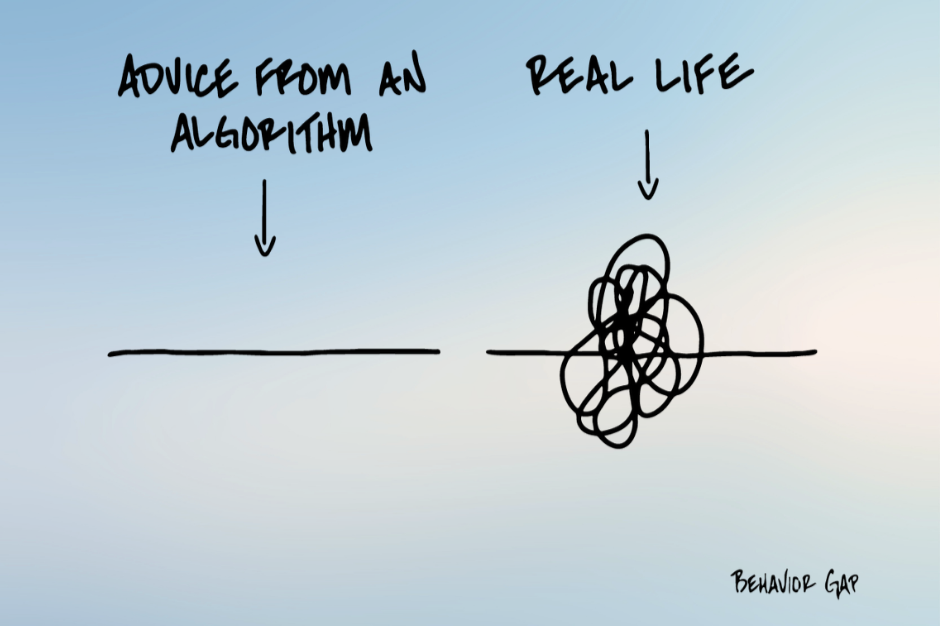
You know what real life looks like? Messy. But you wouldn't know it from most financial plans – not algorithmic ones, anyway.

Most advice out there comes as a straight line. A tidy formula. Clean inputs, clean outputs. Do X, get Y! Save this percentage, retire at that age. Follow these steps, achieve this outcome.

But real life is messier. It's a chaotic tangle of loops and knots and unexpected detours.

And here's the thing about that mess—it's not a bug. It's not a sign you're doing it wrong. It's not evidence that you're bad with money or that you lack discipline. The mess is the point. The mess is what makes us human.

The Seduction of the Straight Line

There's something deeply appealing about algorithmic advice. It’s so clean. Plug in your numbers, and out comes a plan: no ambiguity, no second-guessing. Just follow the formula.

When you're overwhelmed by financial decisions, a straight line feels like relief. Someone—or something—finally has the answer. “Just tell me what to do, and I'll do it!”

Everything’s mapped out. It’s paint by numbers, just like when you were a kid.

But here's what the algorithm doesn't know: it doesn't know that your mother just got diagnosed with cancer and you're trying to figure out if you can afford to take unpaid leave. It doesn't know that your child is struggling in school and needs a tutor you hadn't budgeted for. It doesn't know that you just got an unexpected bonus and you're torn between paying down debt, investing, or finally taking that trip you've been postponing for five years.

The algorithm doesn't know that you're human, and life changes.

Why Math Isn't Enough

Don’t be mistaken - the maths matters. Of course it does! Compound interest is real. Time value of money is real. The difference between a 6% return and an 8% return over thirty years is very real.

But when we reduce money to maths alone, we forget what it feels like to make decisions when you're scared. Or uncertain. Or grieving. Or excited. Or exhausted. Or newly in love. Or watching your industry collapse. Or getting a second chance you never expected.

Financial decisions aren't made in a vacuum. They're made in the tangled middle of actual lives.

That's why human financial advice still matters. Not because humans are better at maths than machines—we're definitely not. But because good advisors know that the maths is just the beginning. The real work is helping people navigate the gap between what the spreadsheet says they should do and what feels possible in their actual circumstances.

Algorithms Optimise, Humans Navigate

Here's what I've learned after years of working with people and their money: algorithms optimise for efficiency. Humans navigate complexity.

An algorithm can tell you the mathematically optimal move. But it can't tell you whether that move is worth the fight it'll cause with your spouse. It can't weigh the emotional cost of saying no to your child’s sports travel team against the financial benefit of staying on track. It can't factor in the value of sleeping soundly at night, even if that means choosing a less "optimal" investment.

There's a reason Japanese retirement homes started removing robots and bringing back human caregivers.1 The robots were more efficient. They didn't get tired. They didn't call in sick. They could lift residents without risking back injuries. But the residents wanted the human touch. They wanted someone who could sense when they needed comfort, not just assistance. Someone who could respond to mood, not just medication schedules.

The same principle applies to money. The algorithm gives you the straight line. The human advisor helps you draw your actual path through the tangled mess.

And sometimes the best financial decision isn't the one that maximizes your net worth. Sometimes it's the one that lets you live with yourself. Sometimes it's the one that honours your values, even when it costs you. Sometimes it's the one that acknowledges you're not just a rational economic agent making optimal choices—you're a person trying to build a life that matters.

You Don't Know Where You Sit on the Curve

Late last year, I wrote about how no one actually knows where they sit on the curve of life's probabilities.2 The algorithm assumes average. But you're not living an average life—you're living your specific life, with your specific luck (good and bad) in any given year. My claims year proved that perfectly.

Some years, you sail through with nothing but routine expenses. The algorithm would call that "optimal."

Other years, everything hits at once. Three family emergencies, a job loss, a health scare, and a busted gearbox. The algorithm would call that "suboptimal" or "poor planning."

Yet, both years are just… life. You didn't do anything wrong in the hard year. You didn't do anything especially right in the easy year. You just lived as normal, where probability meets reality and the straight line becomes a scribble.

The Question Worth Asking

So here's what I want you to ask someone you care about today: What did your budget not account for this past year?

Budgets are great. I believe in them. But they're not magic. Real life always sneaks something in. The car repair. The friend's wedding at the other end of the country. The opportunity you couldn't pass up. The emergency that wasn't really an emergency but felt like one at the time.

Those deviations from the plan? They're not failures. They're data. They're information about what your life actually requires, not what the algorithm thinks it should require.

The straight line is beautiful. But the tangled mess is real. And real is where we have to learn to make good decisions.

Why We Still Seek Human Advice

Here's the deeper truth about why people still seek human financial advice in an age of robo-advisors and AI-powered planning tools: life is dynamic, and our responses need to be too.

A good financial plan isn't static. It breathes. It adapts. It changes when your circumstances change, when your values shift, when unexpected opportunities arise or unwanted challenges appear.

The algorithm updates when you feed it new numbers. The human advisor updates when they see the worry in your eyes, hear the excitement in your voice, sense the hesitation you can't quite articulate. They adjust not just to what has changed, but to how you've changed.

Because here's what the tangled mess really represents: not chaos, but adaptation. Not failure, but responsiveness. Not a deviation from the plan, but evidence that you're paying attention to your actual life and adjusting accordingly.

The straight line assumes the future will be like the past. The tangled line knows better. It knows that life zigs when you expect it to zag. It knows that the best plan is one that can bend without breaking, that can accommodate both disaster and delight, that can hold space for the full complexity of being human.

That's not a bug in the system. That's the whole point of having a life worth planning for.

Nick Stewart

(Ngāi Tahu, Ngāti Huirapa, Ngāti Māmoe, Ngāti Waitaha)

Financial Adviser and CEO at Stewart Group

  • Stewart Group is a Hawke's Bay and Wellington based CEFEX & BCorp certified financial planning and advisory firm providing personal fiduciary services, Wealth Management, Risk Insurance & KiwiSaver scheme solutions.

  • The information provided, or any opinions expressed in this article, are of a general nature only and should not be construed or relied on as a recommendation to invest in a financial product or class of financial products. You should seek financial advice specific to your circumstances from a Financial Adviser before making any financial decisions. A disclosure statement can be obtained free of charge by calling 0800 878 961 or visit our website, www.stewartgroup.co.nz

  • Article no. 440


References

  1. James Wright's research on Japanese eldercare facilities found that care workers often rejected robots like the "Hug" lifting device, preferring to care with their own hands and finding it more respectful to residents. See: Wright, James. Robots Won't Save Japan: An Ethnography of Eldercare Automation (Cornell University Press, 2023); and MIT Technology Review's coverage of robot implementation challenges in Japanese care homes (January 2023).

  2. "Why Self-Insurance Rarely Works," Stewart Group, December 5, 2024


When Good Intentions Meet Poor Planning

A successful professional – let's call him "Mr H" – had built an impressive career and accumulated substantial wealth. He owned property, had invested in overseas estates, and maintained generous pension arrangements.

He also had a complex personal life: an estranged wife he still supported financially, a long-term partner who had borne his only child, and extended family who depended on him.

Before embarking on what would prove to be his final business venture, Mr H added a hasty codicil (an addition) to his existing will. In it, he praised his partner's invaluable contributions to his career and pleaded that she be given "an ample provision to maintain her rank in life."¹ He entrusted her and their young daughter as "a legacy to my company and extended family," confidently expecting that his colleagues and family would honour his wishes.

He was catastrophically wrong.

The Background: A Man at the Height of Success

Mr H had reached the pinnacle of his profession. He was celebrated, wealthy, and influential. He purchased a substantial country estate – a property with elegant gardens, spacious grounds, and all the trappings of success. He paid approximately $2.25 million for the initial property and would eventually expand his holdings to over 160 acres, spending another $2 million on additional land purchases, creating what he called his "paradise."

His partner, Miss E, was instrumental in transforming the property, which featured five spacious bedrooms, two large drawing rooms, a dining room, library, extensive grounds with ornamental gardens, and even an icehouse. Mr H was so delighted with the estate that he repeatedly expanded it, despite his own written advice to Miss E not to acquire anything "too large, for the establishment of a large household would be ruinous."

And oh, the irony of those prophetic words…

The Will: A Masterclass in What Not to Do

Despite his professional acumen and access to the best legal minds of his era, Mr H's estate plan was fundamentally flawed. His original will left his entire estate, including lucrative overseas investments generating substantial annual income, to his brother Mr W (a clergyman). To his partner Miss E, he left only the substantial home and gardens, as well as a modest $125,000 annual income from his overseas estate. His daughter Miss H received $1m for education and a $50,000 allowance annually.²

On paper, these seemed like reasonable provisions. In reality, they were a recipe for disaster.

The problems were immediate and devastating:

Failure #1: No Trust Structure

Despite trusts being well-established legal instruments at the time, Mr H left everything to Mr W outright, apparently assuming his brother would "do the right thing" and support Miss E and Miss H. Family loyalty, after all, should count for something. He didn't even put his wishes in writing within the will itself. He just relied on an understanding between brothers.

He was wrong. Mr W and his wife immediately distanced themselves from Miss E—conveniently forgetting that she had cared for their own children for years while they pursued their own interests, and kept every penny.³ Given Mr H's dangerous profession and rather unique home life situation, a trust would have worked particularly well to protect his vulnerable dependents. A trust would have ensured regular payments to Miss E, protected Miss H's inheritance until she came of age, and prevented Mr W from simply pocketing everything.

But Mr H chose personal trust over legal structure. This was a mistake.

Failure #2: Gifting Encumbered Assets

The substantial home and gardens had been Mr H's pride and joy, his "paradise" where he could finally relax between his demanding work commitments. The property required constant maintenance, employed numerous servants, and demanded significant annual upkeep costs that far exceeded the modest $125,000 annual income Miss E received.²

The estate became an albatross around her neck. She couldn't afford to maintain it properly, yet she couldn't bear to sell her only tangible connection to the man she loved. She was asset-rich but cash-poor, a predicament that would lead to her financial ruin. Had Mr H consulted with estate planning professionals, they would have immediately identified this mismatch between the asset's carrying costs and the income provided to support it.

The property needed either sufficient income to maintain it, or it should have been sold with the proceeds placed in trust for Miss E's benefit. Instead, he gave her an expensive liability disguised as an asset.

Failure #3: Relying on Third Parties

The codicil added just before his final business venture was emotional rather than legally binding. Mr H "hoped" and "trusted" that his business associates would provide for Miss E, citing her work and contributions to the company's success.¹ He wrote movingly about her service and sacrifice, expecting that gratitude and honour would compel them to act.

But hope isn't a legally enforceable instrument. When his business chose to ignore his dying wishes, there was no mechanism to compel them. They threw a lavish $3.5 million funeral celebrating his achievements but didn't spend a penny on his partner or child.² Miss E approached them repeatedly, armed with Mr H's codicil and the testimony of colleagues who had witnessed his wishes. They refused every time.

Had these provisions been written into a binding legal agreement or trust structure, Miss E would have had recourse. Instead, she had only Mr H's heartfelt words… which proved worthless in court.

Failure #4: No Contingency Planning

What if his business refused to honour his wishes? What if Mr W proved ungenerous? What if Miss E fell into debt due to the property's crushing costs? What if she died while Miss H was still a minor; who would protect the child then?

None of these scenarios were addressed. Mr H had made his fortune through strategic planning in his professional life, carefully considering risks and preparing for multiple contingencies. Yet he left his personal affairs almost entirely to chance, apparently believing that good intentions and family loyalty would be sufficient.

The Devastating Aftermath

Miss E tried desperately to maintain the substantial home and gardens as a memorial, entertaining influential contacts in hopes of securing the support Mr H had promised would come. She invested what little money she had into keeping up appearances, hoping that someone – Mr W, the business associates, influential friends – would finally help.

Instead, she fell deeply into debt. With no legal protection and no reliable income, creditors closed in.⁴ The very property that was supposed to provide her with security became her prison. Within just eight years of Mr H's death, she was arrested for debt. She and young Miss H fled the country, living in poverty overseas – a shocking fall for a woman who had once been celebrated in the highest circles of society.

Miss E died in squalor around Miss H's fourteenth birthday, denying to the end that she was the girl's mother – perhaps hoping to spare her daughter the stigma of illegitimacy that would have made her life even harder.⁵ Miss H had to be smuggled back home disguised as a boy to avoid arrest for her mother's debts.⁶ The daughter returned home penniless, her childhood shattered, to be passed between reluctant relatives who viewed her as an unwanted burden.

Meanwhile, Mr W received a $25 million grant to purchase an estate, along with prestigious titles for himself and his son; the very honours Mr H had aspired to but never achieved in life. Other family members received $2.5 million each.² Even Mr H's estranged wife, from whom he had been separated for years, received generous provision.⁷

Everyone was taken care of, except the woman and child he loved most.

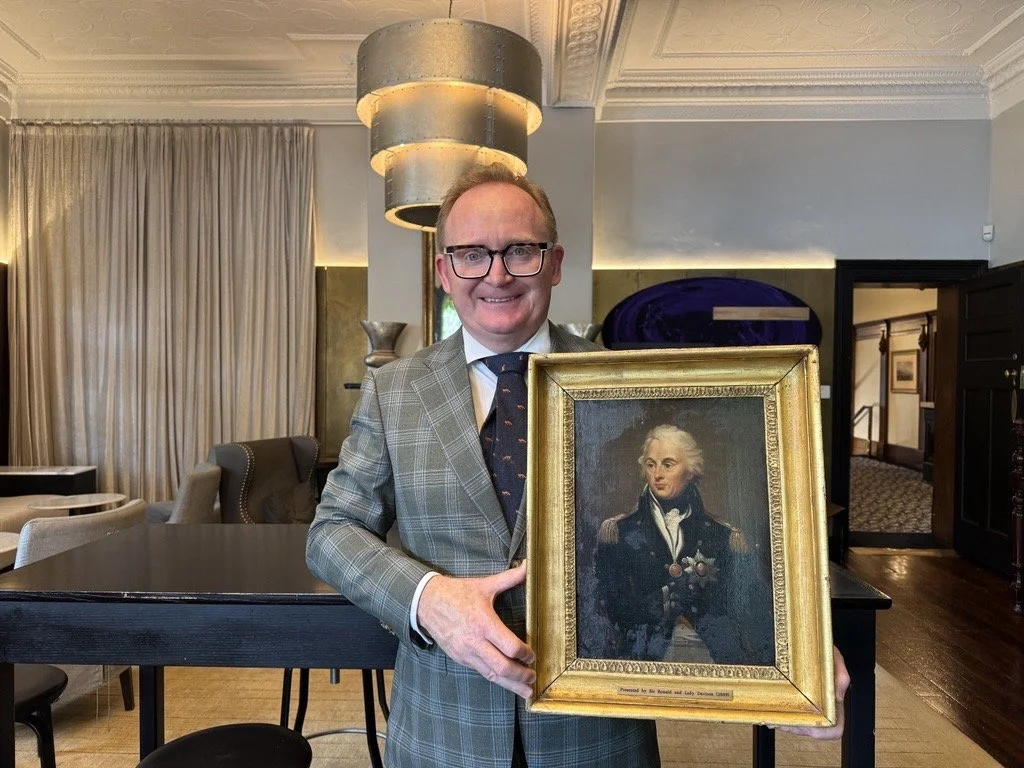
From the Northern Club Art Collection
Title: Portrait of Lord Nelson
Artist: Benjamin West

The Reveal

The saga above isn't hypothetical, nor is it contemporary. This catastrophic failure of estate planning happened over 200 years ago. "Mr H" is Vice-Admiral Horatio Nelson, 1st Viscount Nelson: the most celebrated naval commander in British history, victor of Trafalgar, the man whose column still dominates London's Trafalgar Square. "Miss E" is Emma, Lady Hamilton, "Miss H" is their daughter Horatia, and "Mr W" is his brother, the Reverend William Nelson.

Merton Place, the estate Nelson loved so dearly, was eventually sold off in pieces. Today, the site where Britain's greatest naval hero found his "paradise" is occupied by modern housing estates and a pub called The Nelson Arms. Not a single brick remains of the house where he spent his happiest days.

If someone of Nelson's intelligence, status, and access to legal counsel could make such devastating mistakes, what hope do the rest of us have without proper planning?

6 Lessons for Today’s Investors

The lessons from this 200-year-old tragedy remain relevant today:

1.       Use trusts for complex situations. Don't rely on family members to "do the right thing." Create legally binding structures that ensure your wishes are carried out regardless of personal relationships or good intentions.

2.       Match assets to beneficiaries' actual needs. Don't gift property or assets that require more income than you're providing to maintain them. Consider the total cost of ownership, not just the asset's value.

3.       Make provisions legally enforceable. Emotional appeals and dying wishes carry no legal weight. If you want something done, make it a binding legal obligation, not a heartfelt request.

4.       Plan for contingencies. What if your primary plan fails? What if beneficiaries predecease you? What if relationships change? Good estate planning anticipates multiple scenarios.

5.       Don't let complex personal situations discourage proper planning. If anything, unusual family arrangements demand MORE sophisticated planning, not less. Nelson's situation (an estranged wife, a partner, an illegitimate child, and complex family dynamics) required expert legal structures, not informal arrangements.

6.       Review and update regularly. Nelson's codicil was added hastily before battle. Professional estate planning requires time, thought, and regular review as circumstances change.


200 years later, Nelson's strategic brilliance at Trafalgar is remembered and celebrated. But so is the tragedy of Emma Hamilton and Horatia Nelson, abandoned to poverty and disgrace despite his dying wishes:

“Take care of my dear Lady Hamilton, Hardy. Take care of poor Lady Hamilton.”⁸

He tried. But without proper legal structure and financial planning, good intentions meant nothing.

Nick Stewart

(Ngāi Tahu, Ngāti Huirapa, Ngāti Māmoe, Ngāti Waitaha)

Financial Adviser and CEO at Stewart Group

  • Stewart Group is a Hawke's Bay and Wellington based CEFEX & BCorp certified financial planning and advisory firm providing personal fiduciary services, Wealth Management, Risk Insurance & KiwiSaver scheme solutions.

  • The information provided, or any opinions expressed in this article, are of a general nature only and should not be construed or relied on as a recommendation to invest in a financial product or class of financial products. You should seek financial advice specific to your circumstances from a Financial Adviser before making any financial decisions. A disclosure statement can be obtained free of charge by calling 0800 878 961 or visit our website, www.stewartgroup.co.nz

  • Article no. 439


References

  1. Encyclopedia.com. "Hamilton, Emma (1765–1815)." Women in World History: A Biographical Encyclopedia. Available at: https://www.encyclopedia.com/women/encyclopedias-almanacs-transcripts-and-maps/hamilton-emma-1765-1815

  2. Wikipedia. "Emma, Lady Hamilton." Accessed November 2025. Available at: https://en.wikipedia.org/wiki/Emma,_Lady_Hamilton

  3. Lady Hamilton & Horatio Nelson. "Nelson's Inheritance (part 50)." Words Music and Stories, January 7, 2023. Available at: https://wordsmusicandstories.wordpress.com/2023/01/07/lady-hamilton-horatio-nelson-nelsons-inheritance-part-50/

  4. Wikipedia. "Horatia Nelson." Accessed November 2025. Available at: https://en.wikipedia.org/wiki/Horatia_Nelson

  5. National Museum of the Royal Navy. "The extraordinary life of Horatia Nelson." Available at: https://www.nmrn.org.uk/news/extraordinary-life-horatia-nelson

  6. Find a Grave. "Horatia Nelson Ward (1801-1881)." Available at: https://www.findagrave.com/memorial/6884289/horatia-ward

  7. Lilystyle. "Nelson's Descendants in Brent." Available at: https://lilystyle.co.uk/nelson-s-descendants-in-brent.html

  8. Goode, Tom and Dominic Sandbrook. "RIHC | Nelson EXTRA: The Fate of Lady Hamilton." The Rest Is History podcast, November 5, 2025. Available at: https://podcasts.apple.com/nz/podcast/the-rest-is-history/id1537788786

  9. Merton Historical Society. "A History of Lord Nelson's Merton Place." Available at: https://mertonhistoricalsociety.org.uk/a-history-of-lord-nelsons-merton-place/

  10. Warwick, Peter. "Here was paradise - A description of Merton Place." Available at: https://wandle.org/aboutus/nelson2005/paradise.htm

Note: Historical currency amounts (pounds sterling, circa 1805) have been converted to approximate modern dollar equivalents, accounting for inflation and purchasing power.


Reflecting on 2025: A Final Canny View for the Year

As we close the books on another eventful year, I want to share some final reflections before I put away my pen and keyboard for a well-earned break.

The Year That Was

2025 has been a masterclass in the unpredictable nature of markets.

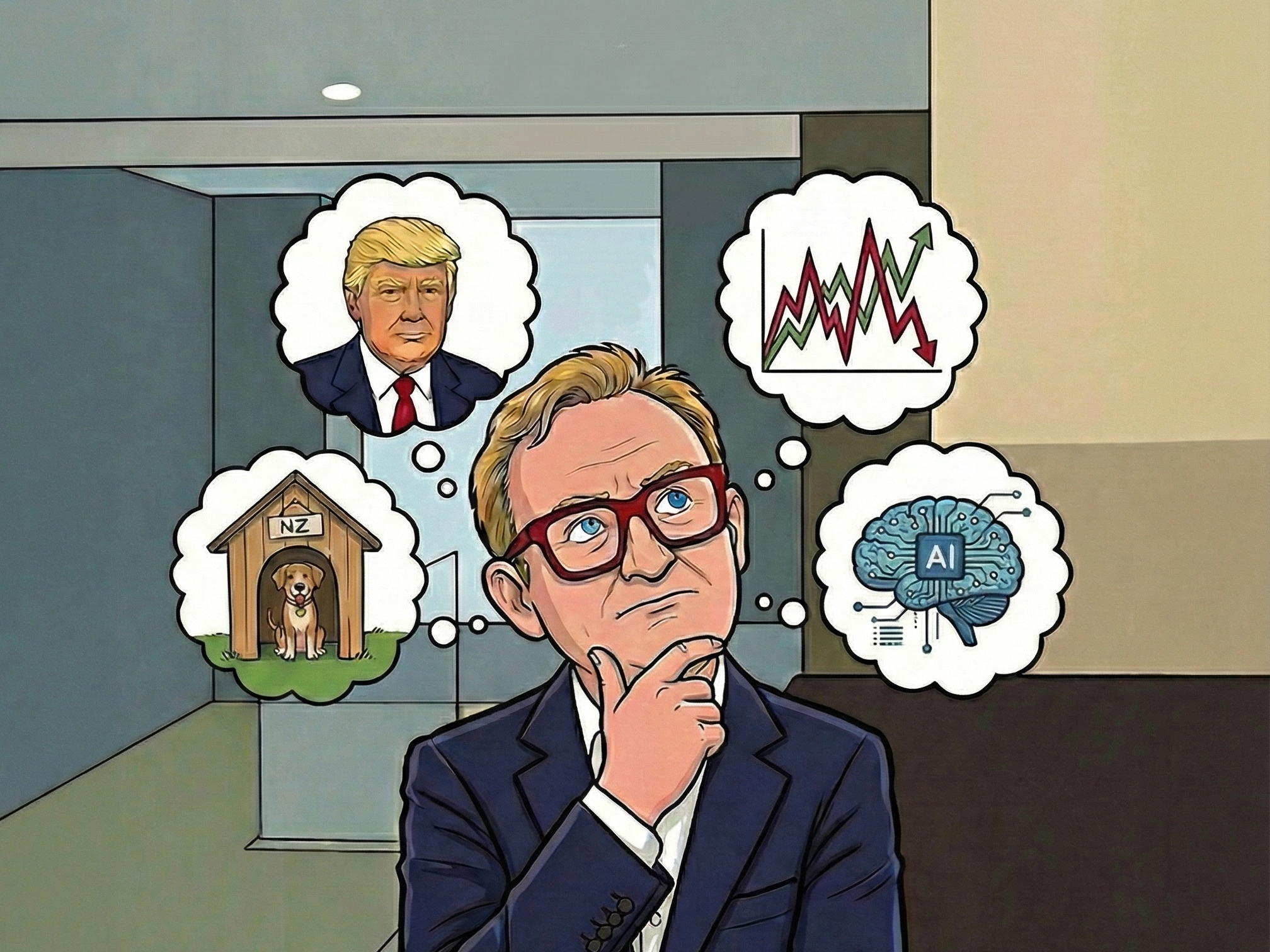
We began the year with President Trump's inauguration and the subsequent tariff theatre that sent shockwaves through global markets in March and April. Despite a sharp -19% drawdown that tested even the most seasoned investors' resolve, global equity markets have delivered another year of above-average returns.

It's a powerful reminder that short-term turbulence is simply the price we pay for long-term prosperity.

The Dog in the Kennel

While many global markets have been out having fun (celebrating AI breakthroughs, peace deals, and strong returns) our New Zealand market has been in the kennel, watching the party from afar. It's been a challenging period for local investors who've seen the disparity between domestic and international performance grow increasingly stark.

Yet – every dog has its day. Recent economic data suggests our dog might be stirring. The balance of trade is looking favourable, and commodity markets for our protein exports remain strong.

These are the foundations that future returns are built upon. Markets move in cycles, and what seems forgotten can suddenly become fashionable again. The New Zealand market won't stay in the kennel forever. Patient investors who maintain diversified portfolios will be positioned to benefit when our local market eventually has its turn in the sun.

Three Lessons Worth Keeping

First, overvalued markets can still grow. The commentators warning about stretched valuations at the start of the year weren't wrong about the numbers; they were just wrong about what those numbers meant for forward returns. Valuation tells us little about timing, and waiting for the "perfect" entry point often means missing out entirely.

Second, knowing what will happen doesn't tell you how markets will react. The tariff announcements in April proved this brilliantly. Everyone knew they were coming, yet the market's bottom came not when clarity arrived, but when uncertainty was at its absolute peak. This is why we plan rather than predict.

Third, long-term planning beats short-term prediction every time. We're living through an AI revolution that will reshape everything, yet we cannot know exactly how or when. The solution isn't better predictions, it's better preparation. A solid financial plan with appropriate asset allocation, a margin of safety, and the discipline to stay invested remains your best defence against an unknowable future.

The Permanent Condition

Uncertainty isn't new, it's the permanent condition of investing. The headlines change, the crises evolve, but the fundamental truth remains: we cannot predict, but we can prepare.

Those who stayed invested through April's anxiety have been rewarded. Those who will stay invested through next year's inevitable turbulence will likely say the same thing in December 2026.

A Time for Gratitude

As I reflect on another year of writing, research, and market commentary, I'm grateful for the readers who engage thoughtfully with these ideas. Whether you're a long-time follower or stumbled across this column recently, thank you for your time and attention.

My aim has always been to cut through the noise and shine a light on the principles that actually matter when it comes to building and protecting wealth. If these weekly reflections have helped you think more clearly about your financial future, make smarter decisions with your capital, or simply feel more confident staying the course during turbulent times, then the effort has been worthwhile.

Safe Travels!

To those of you travelling nationally or abroad over the holiday period, safe travels. To those staying home, enjoy the slower pace and time with loved ones. Whatever your plans, I hope you find moments of rest and renewal.

As for me, I'll be stepping away from the keyboard for two weeks to recharge. Our first article of 2026 will land on 10 January as we look forward to the year ahead. Until then, this will be my last dispatch for 2025.

Whatever 2026 has in store, we'll navigate it together.

See you in the new year.

Nick Stewart

(Ngāi Tahu, Ngāti Huirapa, Ngāti Māmoe, Ngāti Waitaha)

Financial Adviser and CEO at Stewart Group

  • Stewart Group is a Hawke's Bay and Wellington based CEFEX & BCorp certified financial planning and advisory firm providing personal fiduciary services, Wealth Management, Risk Insurance & KiwiSaver scheme solutions.

  • The information provided, or any opinions expressed in this article, are of a general nature only and should not be construed or relied on as a recommendation to invest in a financial product or class of financial products. You should seek financial advice specific to your circumstances from a Financial Adviser before making any financial decisions. A disclosure statement can be obtained free of charge by calling 0800 878 961 or visit our website, www.stewartgroup.co.nz

  • Article no. 438


Should I Invest in What I Love? Product Affection vs Investment Logic

Personal product preferences are often the worst possible guide to investment decisions.

I remember when my family first got a GoPro. Revolutionary technology, stunning footage – everyone wanted one. Naturally, I thought: "This company is going places. Maybe I should buy shares." It's a seductive logic: if I love the product, surely others will too. A decade later, I'm thankful I didn't act on that impulse.

This instinct to invest in what we know and love feels intuitive. We use the products, we understand them, we see their value. But this emotional connection – what behavioural economists call "familiarity bias" – is precisely what makes it dangerous.

Back in 2014, GoPro went public and quickly hit a market capitalization of $10 billion with virtually no competition. Today? The stock trades around $1.87 per share – down 98% from its peak, with over $9.7 billion in market value lost.

What went wrong?

Smartphones killed the action camera star. Modern phones became waterproof, gained multiple lenses, and developed image stabilisation that rivals dedicated cameras. GoPro thought they were competing against other action cameras when they were actually competing against the most successful consumer device in history.

But here's the deeper lesson: loving a product tells you nothing about the company's competitive position or long-term viability. A great product is necessary but far from sufficient for investment success. In GoPro's case, every smartphone manufacturer became their competitor, each with deeper pockets and products consumers were already buying.

The Pattern Repeats Closer to Home

This isn't just an overseas story. Take My Food Bag – during COVID lockdowns, it seemed genius. The company went public in March 2021 at $1.85 per share, raising $342 million. Customers loved the service and bought shares. Many retail investors had enjoyed watching co-founder Nadia Lim cook on TV for years – hardly grounds for a wise investment decision. The result? Shares now trade around 25 cents – an 86% decline. As one fund manager noted, "It was a classic private equity exit, which has seen a lot of retail investors lose out."[1]

The timing seemed perfect. Lockdowns had created new habits. People were cooking at home more. The convenience model made sense. But investors failed to ask: what happens when lockdowns end? Is this a permanent behaviour shift or a temporary adaptation? How defensible is the business model? These are the uncomfortable questions that emotional attachment prevents us from asking.

As one fund manager noted, "It was a classic private equity exit, which has seen a lot of retail investors lose out."

Then there's Ryman Healthcare, beloved by many Kiwi families for good reason. My own family experienced the amazing care and kindness shown towards my late father during his time in the dementia care unit at Ryman in Havelock North. The quality of their villages is genuinely impressive. Yet despite these strengths, the stock hit $10.87 in December 2019 and now trades around $2.87 – down 74%. The investment thesis crumbled under construction delays and regulatory challenges, demonstrating that exceptional service doesn't automatically translate into strong investment returns.

This one hits close to home because the service was excellent. But gratitude and investment logic operate in different domains. A company can deliver outstanding customer experiences while simultaneously facing operational headwinds that undermine shareholder returns.

These three examples share a common thread: product or service quality created an emotional connection that clouded rational investment analysis.

The Evidence Against Emotional Investing

Behavioural finance research identifies "familiarity bias" as a major driver of poor investment decisions, where investors favour what they know rather than what performs best.[2] This bias is particularly pronounced amongst long-term investors who believe they're securing against volatility when they're actually concentrating risk.

The evidence against stock picking is overwhelming:

An Arizona State University study by Professor Hendrik Bessembinder examining over 28,000 stocks from 1926 to 2024 found that just 4% of firms created all net wealth in the U.S. stock market. The remaining 96% collectively matched Treasury bills over their lifetimes, and the majority of individual stocks actually reduced shareholder wealth compared to holding cash.[3]

Think about that. If you picked a stock at random, you'd have better than even odds of underperforming cash. The market's impressive returns come from a tiny fraction of companies – and identifying them in advance is nearly impossible.

Professional fund managers fare no better. S&P Dow Jones Indices' SPIVA Scorecard shows that after 10 years, approximately 85% of large-cap funds underperform the S&P 500, and after 15 years, around 90% trail the index.[4] Even Warren Buffett admits: "In 58 years of Berkshire management, most of my capital-allocation decisions have been no better than so-so."[5]

These aren't amateur investors. These are professionals with research teams, Bloomberg terminals, insider access, and decades of experience. If they can't beat a simple index fund, what makes individual investors think they can, especially when driven by product affection rather than analysis?

The Smart Money Questions

Instead of asking "Do I love this product?", evidence-based investors ask: How big is the addressable market? What prevents competitors from copying this? How strong are the financials? Is the company innovating fast enough? What could make this product obsolete?

These questions are deliberately uncomfortable because they force you to look beyond your emotional attachment. They require research, analysis, and a willingness to acknowledge uncertainty. Most importantly, they shift the focus from "I like this" to "can this company maintain a durable competitive advantage?"

The answers usually point to the same solution: diversification. Diversified index funds consistently outperform stock picking over the long term, providing market-matching returns while reducing the risk of catastrophic losses from individual stock failures.[6]

Diversification isn't glamorous. There's no story to tell at dinner parties about your clever stock pick. But it's precisely this lack of excitement that makes it effective. By owning the entire market, you guarantee you'll own the 4% of companies that generate all the wealth creation, without needing to predict which ones they'll be.

As a fee-only adviser working with evidence-based strategies, the real value isn't in chasing hot stocks or validating product obsessions. It's in building a robust financial plan grounded in decades of research, then maintaining discipline through market noise and emotional temptation.

This discipline is harder than it sounds. When GoPro was soaring, when My Food Bag was listing during lockdowns, when you're genuinely grateful for care received – the emotional pull to invest is powerful. It feels like you have special insight. You don't. You have an emotional connection clouding your judgment.

The most valuable thing a good adviser provides isn't stock tips or market predictions. It's the voice of reason when your emotions are screaming at you to invest in what you love. It's the person who asks the uncomfortable questions: "Have you analyzed the competitive landscape? What's your exit strategy? How does this fit your overall plan?" These questions aren't exciting, but they're essential.

Seek wise counsel, commit to a plan that aligns with your goals, and redirect that energy from stock-picking to living your life. Enjoy the products you love. Be grateful for excellent service. Just don't confuse these feelings with investment insight.

Your future self will thank you for choosing evidence over emotion.

Nick Stewart

(Ngāi Tahu, Ngāti Huirapa, Ngāti Māmoe, Ngāti Waitaha)

Financial Adviser and CEO at Stewart Group

  • Stewart Group is a Hawke's Bay and Wellington based CEFEX & BCorp certified financial planning and advisory firm providing personal fiduciary services, Wealth Management, Risk Insurance & KiwiSaver scheme solutions.

  • The information provided, or any opinions expressed in this article, are of a general nature only and should not be construed or relied on as a recommendation to invest in a financial product or class of financial products. You should seek financial advice specific to your circumstances from a Financial Adviser before making any financial decisions. A disclosure statement can be obtained free of charge by calling 0800 878 961 or visit our website, www.stewartgroup.co.nz

  • Article no. 437


References

  1. My Food Bag Group Limited. (2024-2025). Financial Results and Market Updates. NZX Announcements. Retrieved from https://investors.myfoodbag.co.nz/

    • Devon Funds Management. (2025). "My Food Bag Investment Analysis." RNZ Business Interview, May 22, 2025.

  2. Huberman, G. (2001). Familiarity breeds investment. Review of Financial Studies, 14(3), 659–680. https://doi.org/10.1093/rfs/14.3.659

    • Chew, S.H., Li, K.K., & Sagi, J. (2023). Home bias explained by familiarity, not ambiguity. Social Science Research Network. https://papers.ssrn.com/sol3/papers.cfm?abstract_id=3870716

    • De Vries, A., Erasmus, P.D., & Gerber, C. (2017). The familiar versus the unfamiliar: Familiarity bias amongst individual investors. Investment Analysts Journal, 46(1), 24-39.

  3. Bessembinder, H. (2024). Shareholder wealth enhancement, 1926 to 2022 (Updated through 2024). Arizona State University, W.P. Carey School of Business. Retrieved from https://wpcarey.asu.edu/department-finance/faculty-research/do-stocks-outperform-treasury-bills

    • Bessembinder, H. (2018). Do stocks outperform Treasury bills? Journal of Financial Economics, 129(3), 440-457.

  4. S&P Dow Jones Indices. (2024). SPIVA U.S. Scorecard Year-End 2024. Retrieved from https://www.spglobal.com/spdji/en/documents/spiva/spiva-us-year-end-2024.pdf

  5. Berkshire Hathaway Inc. (2022). Letter to Shareholders. Annual Report 2022.

  6. Malkiel, B.G. (2019). A random walk down Wall Street: The time-tested strategy for successful investing (12th ed.). W.W. Norton & Company.

    • Bogle, J.C. (2017). The little book of common sense investing: The only way to guarantee your fair share of stock market returns (10th anniversary ed.). John Wiley & Sons.

    • Fama, E.F., & French, K.R. (2010). Luck versus skill in the cross-section of mutual fund returns. The Journal of Finance, 65(5), 1915-1947.


To Insure or Not to Insure

Why Self-Insurance Rarely Works

I’m frequently told by people that they’ve been advised by others to skip traditional insurance and simply set up an effective sinking fund: a little reserve where you accumulate all of the insurance premiums you would have otherwise paid to the insurer, using those as your insurance or ‘rainy day’ fund.

In theory, if you’re the average person in the average city receiving all the average results, you remove the middleman and come out ahead financially. It’s an appealing concept that sounds sensible on paper.

However, there are several fundamental problems with this approach.

The Friend-of-a-Friend Phenomenon

Here’s something I’ve noticed: it’s always a friend of a friend who tells the person that self-insurance is a wise call, or they know someone who knows someone that does this successfully. You never actually meet these people, funnily enough.

And of course, for those where it’s been spectacularly unsuccessful, and I’d wager there are far more of these, they’re hardly going to put it on their social media feed or tell their friends about their ill-fated strategy over coffee. It’s the ultimate example of survivorship bias: we only hear the success stories (usually second or third-hand), never the cautionary tales.

I suspect I know why we never meet these successful self-insurers: they simply haven’t had their catastrophic year yet. They’re still in the accumulation phase, feeling clever about their growing balance, not yet tested by the kind of year that wipes out decades of savings in twelve months.

Behavioural and Inflation Challenges

Human nature works against the sinking fund strategy. Behavioural economists have documented what they call “present bias”, our tendency to prioritise immediate needs over future uncertainties.[1] Research from the Financial Markets Authority shows that New Zealanders consistently overestimate their ability to save regularly and underestimate their spending.[2] A “set and forget” sinking fund sounds perfect in theory, but that account becomes the first place people raid when unexpected expenses arise.

There’s also the “optimism bias” at play. Studies consistently show that people believe negative events are less likely to happen to them than to others.[3] This leads to underfunding self-insurance reserves or abandoning them altogether when nothing goes wrong for a few years.

The inflation problem compounds these behavioural challenges. Not all inflation is equal. Medical inflation is far greater than domestic core inflation, to the level of 7.2 times at present, according to recent analysis published in Business Desk.[4]

Construction costs tell a similar story. According to Stats NZ’s Capital Goods Price Index, building costs increased by approximately 42% between 2014 and 2024, while general CPI rose by only 24%.[5] Many New Zealanders only discovered the true cost of construction inflation during Cyclone Gabrielle, when they went to replace their homes. What they thought might cost $300,000 to rebuild suddenly became $450,000 or more.

Your sinking fund may grow at 2-3% annually through interest, while the actual costs you’re protecting against rise at 10%, 15%, or even higher rates. You’re essentially running backwards on a treadmill.

Rat Eating Car Wires

A Personal Reality Check

Let me share my personal experience from the last year, a year I thought would be utterly unremarkable.

I considered myself pretty average: late forties, fit, healthy, gainfully employed and married with kids in their teenage years. We have two cats, one dog, five coloured pet sheep. Our home is well-maintained, no deferred maintenance. My car was serviced on schedule. We have regular health check-ups. Nothing special, nothing unusual.

We are exactly the people you'd expect to sail through the year without incident. Then reality intervened.

First, rats ate out the wiring and suspension system on my car, rendering it completely inoperable. Six weeks in the repair shop. The bill: $18,000.

Then, while out of town, a water cistern in the roof of our home failed, a small $1.20 rubber washer perished, and water came down through the walls and spread across multiple rooms. Wall damage throughout multiple rooms and full carpet replacement due to staining. Four weeks of repairs. The claim: $55,000.

Finally, last month, a small mole on my wife’s leg led to surgery, five nights in hospital, and a health insurance claim of $28,500.

Three unrelated incidents. One year. Total claims: over $101,500.

So much for being average. Even if I’d been religiously funding a sinking fund for twenty years at $5,000 per year, which would require extraordinary discipline, I’d have accumulated $100,000. This single year would have wiped me out completely, leaving me to start from zero at age 49.

That assumes I never once raided the fund for other “emergencies” over those two decades. In reality, most sinking funds would have been depleted long before reaching six figures.

The Fallacy of ‘Self-Insurance’

Let’s put this in perspective: according to Stats NZ, the median household income in New Zealand is around $108,000.[6] My insurance claims for the year essentially equalled an entire year’s median household income, before tax. Even high-income households would struggle to self-fund this level of claims, let alone maintain their standard of living while doing so.

According to the Insurance Council of New Zealand, the average house insurance claim in 2024 was over $15,000, while the average health insurance claim requiring hospitalisation exceeded $20,000.[7] These aren’t amounts that most sinking funds could absorb, especially early in their accumulation phase.

The Commission for Financial Capability found that nearly 40% of New Zealanders would struggle to cover an unexpected $1,000 expense.[8] If we can’t maintain buffers for small shocks, expecting people to maintain funds for potentially catastrophic events is unrealistic.

A Better Solution: Employer-Sponsored Insurance

There’s a middle ground that addresses many of these behavioural and financial challenges: employer-sponsored group insurance schemes. When a company pays for insurance as part of an employee’s remuneration package, it eliminates the temptation to raid the fund or skip payments. The coverage is there, consistently, without requiring ongoing willpower.

One of the most significant advantages of group schemes is that they typically provide cover for pre-existing health conditions – something that can be difficult or impossible to obtain through individual policies. This means employees who may have previously been uninsurable can access comprehensive coverage.

We practise what we preach; our business has provided health, life, and trauma insurance packages as part of our employment package for over a decade. Leading by example, we’ve seen firsthand how this removes the burden of decision-making from employees while ensuring they’re genuinely protected. The group purchasing power also means better rates than individuals could access on their own.

Why Insurance Endures

There’s a reason why insurance has been around for many millennia. It’s because pooling risk across large populations is the only mathematically sound way to protect against catastrophic but unpredictable losses.

When you pay insurance premiums (personally or through an employer scheme) you’re not just paying for potential claims. You’re paying for certainty, for protection against the extreme tail events that can derail your financial life, and for a system that removes the behavioural challenges of self-discipline and forced saving.

Self-insurance sounds empowering and financially savvy. But for most New Zealanders, it’s a gamble that looks good until the moment you desperately need it to work… and discover it doesn’t. The gap between what we intend to do and what we actually do is where self-insurance strategies collapse, leaving people exposed precisely when they need protection most.

My $101,500 year proved that beyond any doubt. Which is why any credible financial plan must include adequate insurance coverage. If your financial adviser isn't discussing insurance protection alongside investment strategy, you're not getting comprehensive advice: you're getting half a plan.

Nick Stewart

(Ngāi Tahu, Ngāti Huirapa, Ngāti Māmoe, Ngāti Waitaha)

Financial Adviser and CEO at Stewart Group

  • Stewart Group is a Hawke's Bay and Wellington based CEFEX & BCorp certified financial planning and advisory firm providing personal fiduciary services, Wealth Management, Risk Insurance & KiwiSaver scheme solutions.

  • The information provided, or any opinions expressed in this article, are of a general nature only and should not be construed or relied on as a recommendation to invest in a financial product or class of financial products. You should seek financial advice specific to your circumstances from a Financial Adviser before making any financial decisions. A disclosure statement can be obtained free of charge by calling 0800 878 961 or visit our website, www.stewartgroup.co.nz

  • Article no. 436


References

[1] O’Donoghue, T., & Rabin, M. (1999). “Doing It Now or Later.” American Economic Review, 89(1), 103-124.

[2] Financial Markets Authority. (2021). “Understanding Financial Capability in New Zealand.”

[3] Weinstein, N. D. (1980). “Unrealistic optimism about future life events.” Journal of Personality and Social Psychology, 39(5), 806-820.

[4] Business Desk. (2024). “Medical inflation outpaces general inflation by factor of 7.2.”

[5] Stats NZ. (2024). “Capital Goods Price Index and Construction Price Index.”

[6] Stats NZ. (2024). “Household income and housing-cost statistics: Year ended June 2024.”

[7] Insurance Council of New Zealand. (2024). “Annual Claims Data Report.”

[8] Commission for Financial Capability. (2023). “Financial Resilience in New Zealand.”

The Squeeze Play: When Essentials Outpace Everything Else

There's a peculiar phenomenon unfolding across New Zealand households, and it doesn't add up. While families cut back on discretionary spending, three relentless forces continue their upward march: rates, power, and insurance premiums.

Kiwibank's latest inflation analysis reveals the problem.[1] Overall inflation sits at 3%, but council rates are up 8.8% year-on-year and electricity has surged 11.3%. Meanwhile, rent and building costs remain soft, responding as they should to economic pressure. This is Economics 101 – except for the outliers that won't bend.

Households respond to price signals by cutting spending, businesses adjust to market conditions, but monopolistic and quasi-monopolistic services continue their upward trajectory regardless of economic headwinds. When essentials become the only thing still inflating, we're not seeing healthy price discovery – we're watching economic dysfunction concentrate in the places people can't escape.

The Democratic Disconnect

In Hastings – Hawke's Bay's largest district – the mayoral election delivered an instructive lesson in vote-splitting. Marcus Buddo had a detailed plan about rates, spending, and debt. Steve Gibson had a plan of ideas. Damon Harvey had a plan of sorts. Between them, they split the centre-right vote.[2][3] Wendy Schollum had a plan to have a plan – and won with 6,722 votes, representing 26.06% of the total vote.[3]

What ratepayers inherited is a focus on process, not outcomes. The problem isn't reviewing assets or benchmarking contracts – it's the absence of a clear plan for cutting spending, reducing debt, and passing savings to ratepayers. In her first month, the new mayor reported focusing on "bringing our new council together," "establishing how we'll work as a team," and "meeting with staff to look at how we can do more with less."[14] Classic "all hui and no doey" [16,17]– lots of meetings, team-building, and singing while rates grow at triple the rate of inflation.[1] 

The RBNZ may deliver some further relief through rate cuts, as economists predict.[1] But that relief will be swallowed by cost increases that don't respond to monetary policy. Council rates aren't discretionary. Power bills aren't negotiable. Insurance premiums exist beyond household bargaining power. The very things households need most are the things rising fastest, creating a squeeze that monetary policy cannot relieve.

The Rates Reality

Hastings imposed a 19% rates increase for 2024/25[5][6] and another 15% for 2025/26.[7] These aren't just numbers on a page – they represent real pain for households already stretched thin by the cost of living crisis. For an average property paying $3,000 annually, rates have jumped to approximately $4,000, with another increase pushing that toward $4,600.

Ratepayers have done their bit – the cyclone-specific targeted rate elevated these increases to the upper band among New Zealand councils. But here's the problem: this is temporary revenue with a 16-year sunset clause,[6] yet spending patterns suggest permanent cost increases have been baked in, with significant portions funding non-cyclone expenditure.

When the cyclone charge expires, does the council try to keep ratepayers paying the cyclone charges to fund other council nice-to-haves, or does it reduce rates? The current trajectory builds in a structural deficit that future ratepayers will inherit. It's a classic government budget problem: temporary revenue streams funding permanent spending commitments. The logic doesn’t add up, and costs get kicked down the road regardless.

Across New Zealand, councils have faced unprecedented cost pressures. A 2024 report commissioned by Local Government NZ found that construction costs for bridges increased 38%, sewage systems 30%, and roads and water supply systems 27% over three years.[8] The average rates increase across the country hit 15% for 2024/25,[8] with some councils proposing even higher increases. But these pressures, while real, don't explain why councils can't find operational efficiencies to partially offset infrastructure cost inflation.

The Residential Reckoning

Nowhere does this squeeze play out more starkly than in residential rental property, where New Zealand's retirement wealth delusion meets economic reality.

For decades, Kiwis were sold a simple story: property is the path to retirement security. Buy a rental. Watch it appreciate. Collect rent. Retire comfortably. It's been cultural gospel, reinforced by favourable tax treatment and the absence of capital gains taxes. An entire generation built its retirement strategy around this asset class.

But that story is fast becoming a tragedy. Residential landlords face the same 8.8% rates increase, insurance premiums that have doubled or tripled post-Gabrielle.[1] These costs aren't negotiable. They simply arrive and must be paid. Unlike businesses that can adjust their cost structures or pass costs to customers, landlords operate in a market with hard ceilings.

Tenants can't just absorb corresponding rent increases endlessly. The market has found its ceiling through the hard limit of what people can actually pay when their own costs are climbing. Tenants are facing their own squeeze – grocery bills up, power bills up, their own insurance costs rising. There's no capacity to absorb 8-11% annual rent increases. So who wears it? The landlord.

When non-negotiable costs grow at 8-11% annually, but rent increases are market-capped at 3-4%, the gap widens, and the squeeze tightens. Properties once generating positive cash flow now require subsidies from other income. The "investment" becomes a wealth destroyer rather than a wealth builder.

The residential property investment model was built for an era where rates grew modestly and insurance was predictable. That era is over. We now have a cohort who bet retirement security on an asset class where holding costs accelerate faster than income. Some will sell. Some will hold on, hoping for capital appreciation to compensate for negative carry. Many will discover too late that their retirement strategy has a fundamental flaw.

It's sad – not because property investors deserve special sympathy, but because it represents massive misallocation of national savings. An entire generation channelled wealth-building into residential property instead of productive assets or diversified investments. Capital that could have funded business growth, innovation, or infrastructure went into bidding up house prices instead. Now they're discovering that when monopolistic cost structures meet market-limited revenue, leverage works in reverse.

The Policy Vacuum

The Kiwibank data disproves the myth of symmetrical adjustment.[1] Households adapt. Markets respond. But essentials march to their own drum, disconnected from broader economic discipline. This asymmetry matters because it means traditional economic responses – tightening monetary policy, reducing household spending – fail to address the source of inflation when it concentrates in monopolistic services.

The government is considering rates-capping legislation to refocus councils on "doing the basics, brilliantly."[10] But rates capping may be only the opening salvo. The Government has just announced proposals to eliminate regional councillors entirely, replacing them with 'Combined Territories Boards' made up of mayors.[15] More significantly, each region will be required to prepare a 'regional reorganisation plan' within two years, with options including merging territorial authorities into unitary councils. The Government's stated goal: "cut duplication, reduce costs, and streamline decision-making."[15]

For councils like Hastings already stretched thin by cyclone recovery, this represents both opportunity and threat.

The opportunity: forced consolidation might finally deliver the operational efficiencies that should have been found voluntarily.

The threat: poorly designed reorganisation could create even larger bureaucracies with less accountability. The pressure to demonstrate fiscal discipline just intensified dramatically.

Council external debt has surged from $353 million in December 2023[11] to $472 million as at 30 June 2025,[13] and is projected to reach $700 million by 2030.[9] That's debt more than doubling in less than three years, with the trajectory showing no signs of slowing. Interest payments alone consume an ever-larger share of rates revenue, creating a vicious cycle where borrowing to fund current operations crowds out funding for actual services.

With voter turnout at just 44.71%[3] and Schollum winning with 26.06% of votes cast, approximately 12% of eligible voters delivered her a victory. She has three years to prove she deserves to be re-elected, which means proving she understands how angry ratepayers are about rate rises. The mandate is thin. The patience is thinner.

For property investors, the question is starker: how long can negative carry be sustained before the retirement wealth strategy becomes the retirement wealth trap? For how many years can landlords subsidise tenants from other income before they capitulate and sell? And when they do sell, who buys investment property with known negative carry characteristics?

Until we confront why essentials climb at double-digit rates while the broader economy slows, we're not solving inflation. We're watching it concentrate in the places people can't escape. That concentration makes the burden harder to bear and the economic distortions more severe.

That's not economics adapting. That's economics breaking down, one essential service at a time.

Nick Stewart

(Ngāi Tahu, Ngāti Huirapa, Ngāti Māmoe, Ngāti Waitaha)

Financial Adviser and CEO at Stewart Group

  • Stewart Group is a Hawke's Bay and Wellington based CEFEX & BCorp certified financial planning and advisory firm providing personal fiduciary services, Wealth Management, Risk Insurance & KiwiSaver scheme solutions.

  • The information provided, or any opinions expressed in this article, are of a general nature only and should not be construed or relied on as a recommendation to invest in a financial product or class of financial products. You should seek financial advice specific to your circumstances from a Financial Adviser before making any financial decisions. A disclosure statement can be obtained free of charge by calling 0800 878 961 or visit our website, www.stewartgroup.co.nz

  • Article no. 435


References

[1] Kiwibank Economics (2025). "NZ Inflation: What's really happening?"

[2] NZ Herald (2024). "Hastings mayoral race - Wendy Schollum claims the win, but her closest rival hasn't conceded."

[3] NZ Herald (2024). "Local elections 2025: Wendy Schollum new Hastings Mayor as last-minute voters extend her lead."

[5] Hastings District Council (2024). "Council reduces proposed rate increase."

[6] Wikipedia (2025). "2022–2025 term of the Hastings District Council."

[7] NZ Herald (2025). "Central Hawke's Bay tries to lower rates hike to 10% as cyclone-hit Hastings sticks with 15%."

[8] 1News (2024). "New Zealand homeowners facing an average rates rise of 15%."

[9] NZ Herald (2024). "Hastings facing one of highest rates rises in country - council could hit $700 million debt."

[10] RNZ (2025). "Local Government New Zealand crying foul over potential rates capping."

[11] NZ Herald (2024). "Hastings District Council nearly $400 million in debt as cyclone costs compound."

[13] Hastings District Council (2025). "2024-2025 Annual Report."

[14] Schollum, W. (2024). Facebook post, Mayor Wendy Schollum of Heretaunga Hastings, November 2024.

[15] New Zealand Government (2025). "Local Government Reorganisation Proposals." BayBuzz Special Alert.

[16] NZ Herald. (2020). Too much hui and not enough do-ey: Why workplace meetings can be wasteful. Retrieved from https://www.nzherald.co.nz

[17] National Māori Authority. (n.d.). Matthew Tukaki on suicide prevention: “Too much hui and not enough doey – so we are taking action right now.” Retrieved from https://www.nationalmaoriauthority.nz

Don't Let Your Adviser's Retirement Disrupt Yours

If you're planning your retirement with a financial adviser who's anywhere near retirement age themselves, you might be setting yourself up for a nasty surprise.

Recent industry data indicates only 10-20% of financial advisers have a documented succession plan, despite many advisers being in their mid-50s and planning to retire within the next decade. Meanwhile, 83% of people with advisers worry about what happens when their adviser retires, and more than half fear they won't receive any warning at all.

That's not just a statistic. It's a wake-up call for Kiwi investors.

You'll Likely Outlive Your Adviser's Career

If you retire at 65, you're likely to live another 25-30 years. According to Stats NZ, life expectancy for a 65-year-old New Zealander is currently 20.6 years for men and 23.2 years for women – and those figures continue to improve over time. Many Kiwis will live well into their 90s, with centenarians becoming increasingly common.

Now consider this: if your 60-year-old adviser plans to work until they're 70, that gives you just 5-10 years of their guidance during a retirement that could span three decades. You'll almost certainly outlive their working life, and quite possibly outlive them entirely.

The mismatch is stark. You need financial guidance for 25-30+ years, but your peer-age adviser might only be around for a third of that journey. Without a proper succession plan, you're facing two decades of uncertainty at precisely the time you need stability most.

The Hidden Risk in Your Financial Plan

Think about the irony for a moment. You hire a financial adviser to help you plan for decades of retirement, ensuring you'll never run out of money or face unexpected disruptions… Yet the person guiding you through this process often hasn't done the same planning for their own practice.

When an adviser retires without a proper succession plan, clients typically get assigned to someone new. Often, it’s someone they've never met.

The investment philosophy might change. The service style could be completely different. It's a bit like when your GP retires without warning and you're left scrambling to find someone new who understands your goals and history.

If you're pre-retirement (around 55 or 60) and working with an adviser who's 65 with no succession plan, you're practically guaranteeing yourself a disruptive transition right as you enter retirement. Even if that adviser works until 70 or 75, you'll still need another 15-20 years of advice after they're gone.

Why Advisers Avoid This Conversation

The reluctance to plan succession isn't malicious; it's deeply human. Creating a proper succession plan requires advisers to share their revenue with younger team members, invest significant time in training and mentoring, and confront their own career endings.

Many simply prefer to coast into semi-retirement rather than undertake this difficult work.

But their comfort shouldn't come at your expense, especially when you're planning for a retirement that could easily span three decades.

What a Proper Succession Looks Like

A well-executed succession plan doesn't happen overnight. The best transitions span multiple years, giving you time to build relationships with next-generation advisers while your current adviser gradually steps back.

You should see:

  • Early introductions to the advisers who will eventually manage your portfolio

  • Gradual transitions where new advisers take on increasing responsibility over 3-7 years

  • Consistent philosophy ensuring your investment approach doesn't change with personnel

  • Clear communication about the timeline and process

  • Demonstrated commitment such as ownership stakes for next-generation advisers

  • Age diversity on the advisory team to ensure continuity


Again, think of it like shopping for a family doctor. You don't want someone in their late 60s or 70s; you want someone who can look after you for multiple decades into the future. The same logic applies to your financial adviser, perhaps even more so given the 25-30 year timeframe you're planning for.

An adviser in their 30s or 40s can realistically serve you throughout your entire retirement. An adviser in their 60s simply cannot, no matter how skilled or dedicated they are.

This doesn’t mean you can’t get advice from an adviser in this age bracket – simply that you need to ask questions about the future.

7 Questions to Ask About Adviser Succession

Don't wait for your adviser to bring it up. Take control by asking:

  1. Do you have a documented succession plan?

  2. Who will work with my family when you retire?

  3. Have I already met this person, or are they yet to be hired?

  4. What's the age range of your advisory team?

  5. How will you ensure my investment approach, services, and fees remain consistent?

  6. What's the timeline for this transition?

  7. Given I might need advice for another 25-30 years, how does your firm plan to serve me throughout my entire retirement?


If your adviser seems uncomfortable or unprepared to answer these questions, that tells you everything you need to know.

Building Succession Into Your Planning

Smart financial planning means thinking holistically about risk. You diversify your investments through KiwiSaver and other portfolios, maintain emergency funds, and plan for healthcare costs. Adviser succession should be part of that same risk management framework.

If you're in your 40s, you might have more flexibility, but you should still favour advisers with clear succession plans. If you're approaching retirement, this becomes non-negotiable. You need an advisory team that can serve you for the next 30 years, not just the next five.

Look for firms that have already made the hard choices – those that have hired and trained next-generation advisers, documented processes and consistent philosophies, and made those younger advisers actual owners in the business. This isn't just good planning; it's a commitment to their clients' long-term wellbeing.

The Bottom Line

Your financial security is too important to leave to chance. The adviser helping you plan for decades of retirement should have spent at least as much time planning for their own succession.

The actuarial reality is clear: at 65, you're looking at potentially 25-30 years of retirement. Your peer-age adviser simply won't be working that long. The question isn't whether succession will happen – it's whether it will happen with planning and care, or chaos and disruption.

Ask the hard questions now. If the answers don't satisfy you, it might be time to find an adviser who's as committed to your future as you are.

Nick Stewart
(Ngāi Tahu, Ngāti Huirapa, Ngāti Māmoe, Ngāti Waitaha)

Financial Adviser and CEO at Stewart Group

  • Stewart Group is a Hawke's Bay and Wellington based CEFEX & BCorp certified financial planning and advisory firm providing personal fiduciary services, Wealth Management, Risk Insurance & KiwiSaver scheme solutions.

  • The information provided, or any opinions expressed in this article, are of a general nature only and should not be construed or relied on as a recommendation to invest in a financial product or class of financial products. You should seek financial advice specific to your circumstances from a Financial Adviser before making any financial decisions. A disclosure statement can be obtained free of charge by calling 0800 878 961 or visit our website, www.stewartgroup.co.nz

  • Article no. 434


Acknowledgements

Special thanks to Keith Matthews of Tulett Matthews and Associates for exploring this critical topic on the Empowered Investor Podcast and highlighting the importance of adviser succession planning for investors approaching retirement.

References

  1. Investment Planning Council (IPC) survey of 1,500+ Canadians with financial advisers, cited in Tulett Matthews & Associates, "Empowered Investor Podcast Episode 120: Don't Let Your Adviser's Retirement Disrupt Yours" (October 2024)

  2. Stats NZ, "National and subnational period life tables: 2017–2019" - Life expectancy data for 65-year-olds in New Zealand

  3. Industry research on adviser succession planning cited in Tulett Matthews & Associates podcast, showing 10-20% of advisers have documented succession plans, with average adviser age of 54 years

Markets, Science, & the Chicago Legacy: Why Evidence Matters More Than Ever

Standing outside the University of Chicago Booth School of Business recently, I was struck by how this building represents something far more valuable than bricks and mortar.

The building bears the name of David Booth, founder of Dimensional Fund Advisors (DFA), whose $300 million donation in 2008 recognised the profound influence this institution has had on how we understand investing. It was the largest gift to any business school in history at the time—and for good reason. The University of Chicago has produced 97 Nobel Prize laureates, making it one of the world’s great centres of economic thought.

I’ve just returned from the United States, where I attended a conference and met with some of the most innovative wealth management firms operating today. What struck me most wasn’t the technology or the marketing—it was the unwavering commitment to letting science, not emotion, drive investment decisions.

The Chicago Revolution

The University of Chicago fundamentally changed how we understand markets. In the 1960s and 70s, Eugene Fama developed the Efficient Market Hypothesis, which challenged the prevailing wisdom that active stock pickers could consistently beat the market. His research, along with work by Harry Markowitz on portfolio theory and Merton Miller on corporate finance, created a scientific framework for understanding how markets actually work rather than how we wish they would work.

 These weren’t armchair theories. They were rigorously tested hypotheses backed by decades of data. Fama won the Nobel Prize in 2013.[1] More recently, Douglas Diamond, who serves as a director at DFA, won the Nobel Prize in 2022 for his groundbreaking research on banks and financial crises.[2] The message is clear: markets are remarkably efficient at incorporating information into prices, making it extraordinarily difficult for active managers to consistently outperform after fees.


From Theory to Practice

This is where David Booth’s story becomes fascinating. After studying under these pioneers at Chicago, he co-founded DFA in 1981 with a radical idea: academic research should drive investment strategy. Rather than trying to pick winners or time markets, DFA built portfolios that captured the dimensions of return that academic research had identified—company size, relative price, and profitability.

The firm’s commitment to its academic foundation remains extraordinary. Eugene Fama himself serves as a director and consultant to DFA, alongside Nobel laureate Douglas Diamond and numerous other distinguished academics.[3] This isn’t window dressing—these researchers actively shape the firm’s investment approach. Today, DFA manages over $850 billion globally and works exclusively with around 1,800 financial advisers and institutions worldwide who share their evidence-based philosophy.[4]

We’ve been fortunate to be part of that community since 2003. Over more than two decades, I’ve had the privilege of meeting David Booth himself, along with many of DFA’s esteemed researchers and team members. These aren’t just business relationships—they’re ongoing dialogues about how markets work and how we can best serve our clients.

But philosophy alone doesn’t pay the bills. The real work happens in translating these academic insights into portfolios that work for real New Zealanders with real goals. Our investment committee builds portfolios that harness these evidence-based principles while respecting each client’s individual circumstances. For some, that means incorporating ESG considerations—ensuring investments align with values without sacrificing returns. For others, it’s about smart tax planning, understanding how PIE funds, FIF rules, and portfolio location decisions can significantly impact after-tax wealth over time. The science tells us what works in markets; our job is to implement it in a way that works for you.


The Emotional Trap

During my US trip, I sat through presentations from wealth management firms managing billions in client assets. A common theme emerged: the biggest threat to investor success isn’t market crashes or economic recessions—it’s investor behaviour itself.

We’re hardwired for emotional responses that work against us in financial markets. We panic when markets fall and become euphoric when they rise. We chase last year’s winners and abandon sound strategies at precisely the wrong moment. We believe we can spot the next big thing, despite overwhelming evidence that even professionals cannot consistently do so.

The firms I met with have built their practices around protecting clients from themselves. They use science-based portfolio construction, maintain discipline during volatility, and focus on what investors can control: costs, diversification, tax efficiency, and most importantly, behaviour.


The New Zealand Reality

Here’s something I hear often: “But surely New Zealand is different?”

It’s not. Market principles are universal. New Zealand shares trade on the same fundamental dynamics as shares in New York, London, or Tokyo. The temptation to believe “it’s different here” often leads to home bias and concentrated portfolios that increase risk without increasing expected returns.

The evidence is unequivocal, regardless of geography. Studies consistently show that the average investor significantly underperforms the very funds they invest in, purely due to poor timing decisions. Research from Morningstar found that investors typically lag their own investments by 1-2% annually simply by buying high and selling low.[5] This behaviour penalty applies equally to investors in Auckland as it does in Austin.

Think about that: a 1-2% annual drag from poor timing decisions alone. Over a 30-year investment horizon, that’s the difference between retiring comfortably and struggling to make ends meet. And it has nothing to do with market returns or fund performance—it’s entirely self-inflicted through emotional decision-making.


What This Means for You

As your advisers, our role isn’t to predict the future or pick winning stocks. It’s to help you stay invested in sensibly constructed, evidence-based portfolios through all market conditions. The science tells us that markets reward patient investors who remain diversified and resist the urge to react to short-term noise.

This matters now more than ever. With 24/7 news cycles, social media investment “gurus,” and the constant temptation to react to market movements, maintaining discipline has never been harder—or more important.

When markets inevitably experience volatility (and they will), remember this: every market downturn in history has eventually been followed by recovery. The investors who stayed disciplined and remained invested captured those recoveries. Those who sold in panic and tried to time their re-entry typically bought back in after much of the recovery had already occurred.

Standing outside that Chicago building, I felt grateful for the legacy of rigorous thinking that continues to shape how we invest today. But the principles that emerged from those halls decades ago remain as relevant now as ever: markets work, diversification matters, costs compound, and behaviour determines outcomes.

The challenge isn’t knowing what to do—science has answered that. The challenge is doing it consistently, especially when markets test our resolve. That’s where good advice becomes invaluable.


Nick Stewart

(Ngāi Tahu, Ngāti Huirapa, Ngāti Māmoe, Ngāti Waitaha)

Financial Adviser and CEO at Stewart Group


References

 [1] The Nobel Prize, “Eugene F. Fama - Facts,” 2013, [nobelprize.org](http://nobelprize.org)

 [2] University of Chicago Booth School of Business, “Douglas W. Diamond Wins Nobel Prize in Economic Sciences,” October 2022, [chicagobooth.edu](http://chicagobooth.edu)

 [3] Dimensional Fund Advisors, “Leadership and Board of Directors,” [dimensional.com](http://dimensional.com)

 [4] Dimensional Fund Advisors SEC Form ADV, showing $835.7 billion in discretionary assets under management as of March 31, 2025

 [5] Morningstar, “Mind the Gap: The Behavior of the Average Investor,” various years, [morningstar.com](http://morningstar.com)

 [6] University of Chicago News, “Alumnus David Booth gives $300 million; University of Chicago Booth School of Business named in his honor,” November 2008, [news.uchicago.edu](http://news.uchicago.edu)​​​​​​​​​​​​​​​​

The 12-Month Tax Gambit: Labour's Calculated Risk

Announcing a major tax policy a year before an election isn't just unusual; it's almost unheard of.

Conventional political wisdom dictates you either implement unpopular measures early in your term, or promise them after securing victory. Labour's decision to foreground a 28% capital gains tax ‘CGT’ a full year out from polling day demands examination, particularly through the lens of economist Arthur Laffer. His insight cuts straight through political calculation: speeding fines are a tax. Governments use taxes to stop people doing things they don't want them to do. So why would you tax investment when the country desperately needs more of it?¹

The timing becomes immediately suspect. Labour sits in opposition facing a National-led government, and historically, opposition parties campaign on aspiration rather than taxation. Helen Clark's 2005 Labour government actively campaigned against CGT proposals, recognising the electoral toxicity.² Yet here we are in late 2025, with Labour essentially writing National's attack ads 12 months in advance.

The Political Theatre

The political play is obvious: announce now, let the controversy "settle," and by election day the CGT feels like old news rather than shocking revelation. Labour hopes voters will be desensitised to what might otherwise be campaign-ending policy. It's political inoculation through extended exposure, with the policy carefully designed as "CGT light" (exempting family homes, farms, KiwiSaver and shares) to avoid the comprehensive wealth taxation that spooked voters in previous attempts.²

Yet as business commentator Damien Grant observes, the policy amounts to "a marketing plan sketched on the back of a napkin that had been used to wipe the lipstick off a chardonnay glass after drinks at a Fabian Society soiree."⁶ The policy amounts to a few pages in a glossy press release with less substance than a frozen coke.

If you own property in July 2027 and sell it after that date, you pay 28% of any increase in value, with no allowance for inflation. Family homes are exempt. That's essentially it—the rest is left to imagination and future consultation.

Recent polling shows Labour's framing is working – 43% support versus 36% opposition.² The 12-month runway allows this narrative to solidify. Labour bets that sustained messaging about "fairness" will ultimately land better than National's "tax on ambition" counter-narrative.

The Fine Fallacy

Laffer's analogy cuts through the fluff. When government fines speeding, fewer people speed – that's the point. When government taxes cigarettes heavily, fewer people smoke – that's the objective. These are taxes deliberately designed to discourage the behaviour.

Applied to investment taxes, the logic is inescapable. When government taxes investment gains at 28%, fewer people invest. Yet that's meant to be revenue-neutral economic policy rather than deliberate discouragement? You cannot fine an activity and simultaneously expect more of it.

The contradiction becomes starker considering New Zealand's actual needs. Treasury warns that 52% of total tax comes from personal income tax, and the group paying this tax is shrinking due to an ageing population.⁴

The country desperately needs productive investment in commercial property, business expansion, and capital formation. Yet Labour proposes taxing precisely these activities, at rates designed to be punitive enough to raise revenue.

This is the economic equivalent of installing speed cameras on the motorway while simultaneously complaining that traffic isn't moving fast enough. You cannot discourage and encourage the same behaviour simultaneously.

The Implementation Damage

The July 2027 implementation date provides convenient political distance: win in November 2026, govern for eight months, then introduce legislation.²

But here's where political cleverness creates economic damage - the announcement effect begins immediately. Why would a developer start a commercial property project in 2026 knowing that any gains realised in 2028 or 2029 will face 28% taxation? Investment decisions from now until 2027 will be distorted by anticipated future taxes, locking capital out of productive uses or sending it offshore.³

The economic damage begins not when the tax takes effect, but when it's announced. We're living through that damage period now. The speeding camera has been installed, and the signs are up; don't be surprised when drivers slow down.

The British Warning

Laffer's analysis of Gordon Brown's decision to raise Britain's top rate from 40% to 50% provides the cautionary tale. The UK Treasury's own "Laffer section" showed the increase "not only did not get more revenue, it got you a lot less prosperity. People left the country, people used tax shelters, dodges, loopholes, all that."¹ As Laffer emphasised, this wasn't his opinion imposing American economics on Britain—"This was Britain doing the Laffer curve."¹

As Laffer notes from decades of US tax data: "Every time we've raised the highest tax rate on the top 1% of income earners, three things have happened. The economy has underperformed, tax revenues from the rich have gone down, and the poor have been hammered."¹

Conversely: "Every single time we've lowered tax rates on the rich, the economy has outperformed. Tax revenues from the rich have gone up and the poor have had opportunities to earn a living, to live a better life."¹

The Practical Nightmares

The practical problems compound the economic ones. Grant notes that inflation has already created havoc in Australia, where properties often can't be sold “because almost all of the price is considered a capital gain. This will be worse on the Hipkins plan because there is no indexation.”⁶

Consider a property bought in 2015 for $500,000 is now worth $800,000. Under Labour's plan, the entire $300,000 gain faces 28% taxation – that’s $84,000. But how much of that gain is real appreciation versus inflation? Without indexation, investors pay tax on phantom gains that merely reflect currency debasement.

Meanwhile, definitional nightmares await. Australia's capital gains tax guide runs to 339 pages, with court judgements adding hundreds more.⁶ Is replacing a kitchen a capital improvement or maintenance? What about landscaping? A 2028 Fisher and Paykel dishwasher replacing a 1980s Westinghouse: expense, or capital upgrade? As Grant notes drily: "Tax lawyers and accountants will be kept busy."⁶

The Chartered Accountants Institute supports Labour's proposal – hardly surprising, given it guarantees full employment for their profession dealing with compliance complexity.

The Fiscal Illusion

Even Chartered Accountants acknowledge that CGTs "do not generate significant revenue in the short or even medium terms. Long term, however, they typically provide a steady revenue stream… Using them to cover a specific policy expense is unusual."⁴ Yet Labour wants to use this non-existent revenue immediately to subsidise doctor visits.

As Grant observes: "There is a cash shortfall on Labour's own analysis in the early years which, like everything else in this policy, the resolution is left to the imagination."⁶ Here's the speeding fine logic again: if you install cameras to generate revenue from fines, you're simultaneously reducing the very behaviour that generates the revenue.

Successful speed cameras mean less speeding, and therefore less revenue. A capital gains tax that successfully deters property speculation means less property investment, and again, less revenue.

The Historical Pattern

This is Labour's seventh CGT attempt since 1973.² Norman Kirk's first attempt taxed gains at up to 90%, a rate so confiscatory it was quickly abandoned. Phil Goff's 2011 version, David Cunliffe's 2014 proposal, and Jacinda Ardern's 2019 attempt all failed politically.

Each previous effort proved politically costly and economically counterproductive. Voters instinctively understand Laffer's speeding fine logic, even if they can't articulate the economics by name. They recognise taxing investment reduces investment, just as fining speeding reduces speeding. Winston Churchill’s timeless observation perfectly captures the impossibility of taxing your way to prosperity – you cannot stand in a bucket and lift yourself up by the handles.⁵

The Alternative Vision

Laffer's prescription for struggling economies is brutally simple: "You want a low-rate, broad-based flat tax, spending restraint, sound money, minimal regulations, and free trade. And then get the hell out of the way."¹ Labour offers the opposite with new taxes on capital, sketchy implementation details, and revenue projections that don't add up.

As Laffer puts it: "Poor people don't work to pay taxes. They work to get what they can after tax. It's that very personal and very private incentive that motivates them to work, to quit one job and go to another job, to get the education they need to do it."¹ Replace "poor people" with "investors" and the logic remains - capital seeks returns. Tax those returns heavily enough, and capital goes elsewhere.

Perhaps most revealing: if this policy were genuinely beneficial for economic growth, why the elaborate political choreography? The answer lies in Laffer's observation about lottery tickets: "Everyone—tall, short, skinny, fat, old, young—they all want to be rich. Why does your government then turn around and tax the living hell out of the rich?"¹

New Zealanders don't want to punish success; they want pathways to achieve it themselves. They buy lottery tickets hoping to strike it rich. The government encourages dreams of wealth while simultaneously taxing the achievement of wealth.

The Verdict

The election will shortly reveal whether Labour's calculated 12-month strategy succeeds politically. By announcing early, they've given the policy time to settle, given themselves something concrete to campaign on, and satisfied membership demands for action on wealth taxation.

But both Laffer's economic analysis and Grant's practical critique suggest that regardless of electoral outcome, the policy itself represents strategic error. It's economic theory ignored in favour of political positioning.

New Zealand has better options. Genuine broadening of the tax base, reform of property taxation to encourage productive use, addressing infrastructure bottlenecks, and creating conditions for productivity growth would all contribute more to long-term prosperity than taxing capital gains at 28%. But those approaches require the hard work of reform rather than the easy politics of taxing "wealthy property investors."

Is Labour's CGT announcement politically canny, or economically catastrophic? When you deliberately discourage an activity through taxation, you can’t be surprised when you get less of it.

Labour has installed the camera; investment will slow accordingly. Whether that's clever politics or economic self-harm depends entirely on whether you're focused on winning the next election or building the next generation's prosperity.

As Laffer would note, you cannot tax an economy into prosperity. And you most certainly cannot stand in a bucket and lift yourself up by the handles.

Nick Stewart
(Ngāi Tahu, Ngāti Huirapa, Ngāti Māmoe, Ngāti Waitaha)

Financial Adviser and CEO at Stewart Group

  • Stewart Group is a Hawke's Bay and Wellington based CEFEX & BCorp certified financial planning and advisory firm providing personal fiduciary services, Wealth Management, Risk Insurance & KiwiSaver scheme solutions.

  • The information provided, or any opinions expressed in this article, are of a general nature only and should not be construed or relied on as a recommendation to invest in a financial product or class of financial products. You should seek financial advice specific to your circumstances from a Financial Adviser before making any financial decisions. A disclosure statement can be obtained free of charge by calling 0800 878 961 or visit our website, www.stewartgroup.co.nz

  • Article no. 433


References

  1. Simmons, M. (2024). Reality Check: Interview with Arthur Laffer. Times Radio.

  2. Opes Partners (2025). 'Does New Zealand Have a Capital Gains Tax? [2025]'. Available at: https://www.opespartners.co.nz/tax/capital-gains-tax-nz

  3. RNZ (2025). 'What you need to know: Seven questions about a capital gains tax'. Available at: https://www.rnz.co.nz/news/business/577065/what-you-need-to-know-seven-questions-about-a-capital-gains-tax

  4. Chartered Accountants Australia and New Zealand (2025). 'Capital gains tax must be considered as part of tax reform'.

  5. Churchill, W.S. (1906). For Free Trade. London: Arthur Humphreys.

  6. Grant, D. (2025). 'Hipkins' capital gains tax policy leaves more questions than answers'. Stuff. Available at: https://www.stuff.co.nz/politics/360878756/damien-grant-hipkins-capital-gains-tax-policy-leaves-more-questions-answers

When Ideology Replaces Analysis: The Sparrow Lesson for Investors

It's fairly well known that Mao Zedong's Great Leap Forward (1958–1962) ended in one of history's deadliest famines: tens of millions died, villages emptied by hunger, fields stripped bare. What's less well known is how a war on sparrows helped set the catastrophe in motion.  [1]

‘Ed Brown’ by Michael Parekowhai, 2000 - A favourite of Nick’s that hangs on the wall at home.

In 1958, Mao launched the Four Pests Campaign, targeting rats, flies, mosquitoes… and sparrows. The tiny birds, he decreed, were "enemies of the people" for daring to eat the people's grain.  [2]

And so, an entire civilisation mobilised against the feathered menace. Schoolchildren banged pots and pans in the streets, peasants drummed on washbasins, and factory sirens screamed for hours to keep the birds in flight until they fell dead from exhaustion. Nests were torn down, eggs smashed, and chicks stomped into the earth.

The results were biblical. In Beijing alone, more than a million sparrows were killed in a matter of weeks. Rural communes competed to see who could pile the highest mountain of avian corpses, a kind of grotesque festival of progress.

But victory, when it came, was short-lived. The sparrows, it turned out, had been eating more insects than grain. Within a year, the skies were empty, and the earth was crawling. Locusts rose like living clouds, devouring fields from horizon to horizon. Peasants watched in horror as the crops disappeared into the mandibles of an unstoppable plague of their own making.

Rather than admit his mistake, Mao doubled down on absurdities. He replaced the sparrows with imported Soviet "science" – the theories of Trofim Lysenko, an agronomist who believed that crops could be re-educated through hard labour. Genetics was bourgeois nonsense, Lysenko said; what mattered was enthusiasm. If you ploughed deeper, planted closer, and shouted revolutionary slogans loudly enough, the harvest would multiply.

So, fields were churned to depths that eviscerated the biome, seedlings were planted shoulder to shoulder until none could breathe, and bureaucrats inflated yields to impossible heights. Mountains of fake grain were reported; much of the real grain was exported to show socialist success.

By 1960, China was starving. Whole provinces were dying in silence. Still, the propaganda blared: "The people's communes are good!"

A survivor later put it simply: "We killed the birds, and then the insects ate everything else."

New Zealand's Sacred Cow

We have our own version of Lysenko's ideology. You've heard it at every barbecue, every family gathering, every pub conversation about money:

  • "You can't go wrong with bricks and mortar."

  • "Buy land – God's not making any more of it."

  • "Rent money is dead money."

  • "Safe as houses."

  • "Property always goes up."

For two decades, these mantras proved prophetic. House prices in Auckland rose 500% between 2000 and 2021. Kiwi households saw their home become their retirement plan, their children's inheritance, their ticket to prosperity. Property investment became a religion, complete with its own prophets (real estate agents), its own evangelists (property coaches), and its own scripture (Rich Dad Poor Dad).

The scriptures were simple: leverage to the hilt, buy multiple rentals, negative gear against your income, and watch the capital gains roll in. Interest rates were at historic lows (and surely they'd stay there forever). The government needed house prices to keep rising; from pensioners to banks, the entire economy seemed to float on residential property values.

Alas - ideology, no matter how many believers it has, eventually meets mathematical reality.

When the Locusts Arrived

When the Reserve Bank lifted the Official Cash Rate from 0.25% to 5.5% between 2021 and 2023, the proverbial locusts began to swarm and feast.  [3]

Investors who'd stretched to buy rental properties on interest-only loans at 2.5% suddenly faced repayments double what they'd planned for. Those who'd bought at the peak in 2021, with the assumption that prices would continue relentlessly marching upward, now watched their equity disappear into the maw of change.

The median house price in New Zealand has fallen 18% from its 2021 peak according to CoreLogic, with steeper declines in some regions. In Wellington, prices dropped over 20%.  [5], [4]

Investors who bought at the top, banking on endless capital gains to compensate for negative cash flow, are now holding properties worth less than their mortgages. Negative equity isn't just an American problem from the 2008 crisis anymore; it's arrived in Epsom and Island Bay, in Christchurch and Hamilton. [5]

Mortgage stress has become a daily reality for thousands of New Zealand families. What was affordable at 2.5% is crushing at 7%. Property gambles that made sense when you could lock in cheap debt for years, now bleed money every month.

The Property Value Fundamentals We Ignored

Like Mao's bureaucrats ignoring the ecology of pest control, New Zealand ignored the fundamentals that underpin property values:

1.     Debt serviceability

We convinced ourselves record-low interest rates were the new normal; a pleasantly permanent feature of the economic landscape.

They weren't. They were weather, not climate.

Anyone who'd stress-tested their mortgage at 7% rates had a good idea what this would look like, but most didn't bother. After all, the Reserve Bank had signalled rates would stay low until 2024, hadn't they? (They had. They were wrong.)

2.     Yield vs. cost

Rental properties returning 3% gross yield while mortgages cost 7% represents what economist Hyman Minsky termed "Ponzi finance"—where income flows cover neither principal nor interest charges, requiring continuous new debt or capital appreciation to survive [6]. When prices stopped rising, the mathematics became unavoidable. You can't lose money every month and call it investing just because you hope the asset will appreciate.

3.      Supply and demand

Yes, God's not making more land. But man is making more zoning laws, more construction, and more high-density housing. Auckland's recent upzoning has added the potential for tens of thousands of new dwellings. National's push for urban intensification is changing the supply equation.

Supply does respond to price eventually. The assumption that demand would endlessly outstrip supply was ideology, not analysis.

4.     Demographic and economic shifts

Net migration swings wildly:

  • We saw massive outflows to Australia when its economy boomed.

  • Birth rates are falling.

  • Working from home changed where people want to live, making provincial cities more attractive.


How to Avoid Being the Sparrow Killer

No investment is exempt from fundamental analysis – not even the quarter-acre Kiwi dream. Here’s what you need to do:

Test your assumptions first

Before buying property (or any investment), ask the hard questions: Can I afford this if interest rates hit 8%? What if the property stays vacant for three months? What if it needs a $30,000 roof replacement? What if prices don't rise for a decade—can I still hold on? If your investment only works under best-case scenarios, you're not investing—you're gambling with borrowed money.

Recognise ideology masquerading as wisdom

When someone says "you can't go wrong with property”: ask them about Japan, where house prices fell for fifteen consecutive years after 1991 with Tokyo property losing 60% of its value. Or Ireland, where property crashed 50% in 2008-2012. Or Detroit, where homes now sell for less than second-hand cars. [6]

The phrase "you can't go wrong" is the most dangerous in investing. You absolutely can go wrong with property, shares, bonds, or any other asset – when you pay too much, borrow too heavily, or ignore the fundamentals.

Understand that all assets are priced relative to alternatives

When term deposits paid 0.5%, property's 3% gross yield looked attractive by comparison. At 5.5% risk-free rates from the bank, suddenly that leveraged rental property earning 3% gross (maybe 1% after rates, insurance, maintenance, and management) looks substantially less clever. Capital always flows to its best risk-adjusted return. When safe returns become attractive again, risky assets must reprice.

Seek Wise Counsel

Honest, professional financial advice isn’t just valuable in these situations; it’s essential.

Not the mate at the barbecue repeating what worked in 2015. Not the property spruiker selling $5,000 weekend seminars on wealth creation. Not the Instagram influencer with a Lamborghini, a course to sell, and a P.O. box in the Cayman Islands.

Find an adviser who'll tell you hard truths instead of comfortable lies. Someone who'll stress-test your assumptions, challenge your thinking, and ask the questions you don’t want to acknowledge:

  • What if you're wrong?

  • What if rates stay high for five years?

  • What if prices don't recover for a decade?

  • What does your portfolio look like if this happens?

 The best financial advice often sounds boring. That’s because it is boring: it involves diversification across asset classes, appropriate leverage you can service in bad times, understanding what you own and why, and planning for scenarios you hope won't happen.

It's not a catchy slogan you can repeat at a dinner party. It's certainly not exciting enough to build a social media following around.

Instead, it's mathematics, discipline, humility, and the wisdom to know that "everyone's doing it" has never – not once in the history of markets – been a sound investment strategy. Quite the opposite; when everyone's doing it, that’s usually a good moment to step back and ask why.

Mao surrounded himself with yes-men who told him what he wanted to hear. The sparrows paid the price. Then the insects thrived. Then the people paid the price. The echo chamber produced catastrophe because ideology replaced observation, and enthusiasm replaced analysis.

The Bottom Line for Kiwi Investors

Don't let your financial future be decided by mantras. Don't let social ‘proof’ substitute for due diligence. And crucially, don't assume what has worked for the past twenty years will work for the next twenty.

Instead, seek counsel that respects the complexity of markets, acknowledges uncertainty honestly, understands risk as well as reward, and helps you build wealth on foundations stronger than popular sentiment or revolutionary enthusiasm.

The fundamentals always win. Always. The only question is whether you'll be positioned to weather the fallout, or whether you’ll be left exposed in the fields.

The locusts are always waiting.

Nick Stewart
(Ngāi Tahu, Ngāti Huirapa, Ngāti Māmoe, Ngāti Waitaha)

Financial Adviser and CEO at Stewart Group

  • Stewart Group is a Hawke's Bay and Wellington based CEFEX & BCorp certified financial planning and advisory firm providing personal fiduciary services, Wealth Management, Risk Insurance & KiwiSaver scheme solutions.

  • The information provided, or any opinions expressed in this article, are of a general nature only and should not be construed or relied on as a recommendation to invest in a financial product or class of financial products. You should seek financial advice specific to your circumstances from a Financial Adviser before making any financial decisions. A disclosure statement can be obtained free of charge by calling 0800 878 961 or visit our website, www.stewartgroup.co.nz

  • Article no. 432


References

[1] F. Dikötter, *Mao's Great Famine: The History of China's Most Devastating Catastrophe, 1958–-1962*.. London: Bloomsbury Publishing, 2010.

[2] J. Shapiro, *Mao's War Against Nature: Politics and the Environment in Revolutionary China*.. Cambridge: Cambridge University Press, 2001.

[3] Reserve Bank of New Zealand, “Official Cash Rate decisions and historical data,”, 2024. [Online]. Available: https://www.rbnz.govt.nz

[4] Real Estate Institute of New Zealand (REINZ), “Historical house price data and market statistics,”, 2024. [Online]. Available: https://www.reinz.co.nz

[5] CoreLogic New Zealand, “House price indices and market analysis reports,”, 2024. [Online]. Available: https://www.corelogic.co.nz

[6] H. P. Minsky, “The Financial Instability Hypothesis,”, The Jerome Levy Economics Institute Working Paper No. 74, 1992.


Not all that Glitters: A Hawke’s Bay Perspective on Investment Lures

Walking your dog along the banks of the Tuki Tuki River on a crisp Hawke's Bay morning, you might spot an angler casting their line into the current. If you look closely at the tackle box, you'll find an array of brightly coloured lures - fluorescent pinks that practically glow in daylight, electric greens that shimmer with an unnatural brilliance, shimmering silvers that catch every ray of sun. Each one is a masterpiece of design, engineered to trigger a response. They're designed to catch something, all right. But it's not always the fish.

Lures work because they exploit instinct. That flash of silver mimics a wounded baitfish. The vibrant pink stands out against murky water. The electric green triggers a predatory response. But here’s the thing - the lure doesn’t need to fool the fish to be successful. It only needs to fool the angler into buying it. The brightest, most eye-catching lures often sit in tackle boxes, never touching water, while experienced fishers reach for duller, more practical options that actually work.

Charlie Munger, the late investing legend and Warren Buffett’s long-time partner, once recounted a conversation that cuts to the heart of how financial products are really sold. He’d asked a fishing lure salesman whether fish actually bit on those garish purple and green contraptions. The man’s response was disarmingly honest: “Mister, I don’t sell to fish.” [1]

That simple line exposes an uncomfortable truth about the investment industry - one that’s struck particularly close to home here in Hawke’s Bay in recent times. In October 2025, the Financial Markets Authority issued a formal warning to Finbase (HP Capital Limited) over serious breaches relating to their Single Investment financial products - essentially property lending arrangements.[2] This is the same company that had been running full-page advertisements in the Hawke’s Bay Today, using search terms like “term deposit” and “low risk investment NZ” to attract investors.

But there’s more. Also in October, MyFarm Investments’ Rākete Orchards partnership, which grows Rockit apples across six Hawke’s Bay orchards valued at $17.4 million, entered voluntary administration. [3]  When launched in late 2017, the investment closed oversubscribed at $13 million, with forecasts of returns exceeding 50-55% per annum. [4]  Those shiny projections now look very different.

The irony is impossible to miss. Full-page ads in our local paper projecting stability and legitimacy - the investment equivalent of fluoro pink lures. Promises of safety using familiar terms like “term deposit” - the shimmering silver that mimics something trustworthy. Bold marketing campaigns featuring impressive return projections - the electric green designed to stand out from everything else. None of it was designed to catch fish. It was all designed to catch us.

The FMA found that Finbase’s advertising created a false impression that their investment products were comparable to term deposits when they differed significantly in nature and characteristics.[2] The use of familiar, reassuring terminology masked the real nature of the investment and its risks. Meanwhile, Rākete’s chair blamed low returns, noting that demand hadn’t grown sufficiently, and high costs meant returns were insufficient to support ongoing operations.[5]

Humans are predictable creatures, and decades of behavioural finance research has mapped our psychological vulnerabilities. We’re drawn to familiar-sounding terms because they trigger associations with safety and certainty. We’re attracted to branded agricultural products because they seem tangible, real, and connected to what we know. We trust advertisements in our local newspaper more than we probably should. The investment industry understands this intimately and constructs marketing designed to activate them, whether or not the product serves our actual interests.

Here in Hawke’s Bay, we pride ourselves on straight talk and honest work. Our regional economy is built on things you can touch and understand - orchards heavy with export-quality apples, vineyards producing wines that compete on world stages, farms raising premium livestock. There’s no mystery about how value is created in these industries. You plant, you tend carefully, you harvest, you continually improve your methods. Real results come from patience, expertise, and time.

Successful investing follows these same unglamorous principles. It’s buying quality businesses at reasonable prices and holding them through inevitable market cycles. It’s diversifying sensibly across different asset classes and geographies. It’s keeping costs and fees low. It’s maintaining emotional discipline when markets fluctuate. It’s resisting the powerful urge to chase whatever looks shiniest or promises the highest returns.

This approach doesn’t generate compelling marketing copy. It doesn’t require full-page advertisements. It doesn’t promise 50%+ annual returns that sound too good to be true. But that’s precisely why it’s harder to sell. Boring doesn’t capture attention. Prudent diversification doesn’t create excitement. Modest, realistic projected returns don’t make headlines.

When someone presents an investment opportunity backed by aggressive marketing - whether splashed across the Hawke’s Bay Today or promoted through carefully optimised online search terms - ask yourself fundamental questions: Is this designed to catch fish, or catch me? Why does something supposedly offering solid, legitimate returns need this level of promotional spending? What happens if rosy projections don’t materialise? What are the realistic worst-case scenarios?

This is where seeking wise counsel becomes essential. Look for advisers with rigorous due diligence processes and recognised certifications like CEFEX, which demonstrates commitment to fiduciary excellence and systematic client protection.[6] These aren’t shiny credentials designed to impress - they’re evidence of thorough, unglamorous processes that protect investors.

A good adviser asks uncomfortable questions about any investment: What are the real, not theoretical, risks? How dependent is success on optimistic assumptions about markets, demand, or costs? How liquid is this investment if circumstances change? Can you genuinely afford to lose this money? Most importantly, have similar investments really delivered returns as promised, or is there a pattern of disappointments?

Finbase exceeded regulatory limits and used advertising that misled potential investors about fundamental product characteristics.[2] With Rākete, even real orchards growing actual apples in Hawke’s Bay soil didn’t deliver the projected economics. Other Rockit growers reported returns well under the $1.10 per tube needed to break even, forcing difficult decisions about their orchard futures.[3]

The consequences of getting these decisions wrong aren’t abstract. They affect real people in our community - retirees who thought they were safely parking their retirement savings, families who believed they were making prudent decisions while supporting local agriculture, individuals who trusted that bold advertising in their trusted local newspaper meant something had been thoroughly vetted and deemed appropriate for ordinary investors.

The magpie, despite its considerable intelligence, can’t resist a shiny object. It’s hardwired evolutionary instinct. But we can do better.

Next time you’re walking your dog along the Tuki Tuki and see those bright lures glinting in an angler’s tackle box - let them serve as a useful reminder. The brightest lures are often the ones that never get wet. In fishing, as in investing, the flash and colour serve one primary purpose - to catch you, not the fish.

Because the question isn’t whether the lure looks attractive, uses comfortable terminology, appears in trusted publications, or involves tangible Hawke’s Bay assets. The question is simple and profound: who is it really designed to catch?

Your financial future deserves better than bright colours and borrowed credibility. It deserves honesty, transparency, realistic assumptions, thorough due diligence, and advice that genuinely serves your interests rather than someone else’s sales commission.

Unless you’re a magpie, you don’t have to take the bait.

Nick Stewart
(Ngāi Tahu, Ngāti Huirapa, Ngāti Māmoe, Ngāti Waitaha)

Financial Adviser and CEO at Stewart Group

  • Stewart Group is a Hawke's Bay and Wellington based CEFEX & BCorp certified financial planning and advisory firm providing personal fiduciary services, Wealth Management, Risk Insurance & KiwiSaver scheme solutions.

  • The information provided, or any opinions expressed in this article, are of a general nature only and should not be construed or relied on as a recommendation to invest in a financial product or class of financial products. You should seek financial advice specific to your circumstances from a Financial Adviser before making any financial decisions. A disclosure statement can be obtained free of charge by calling 0800 878 961 or visit our website, www.stewartgroup.co.nz


References

  1. Poor Charlie's Almanack: The Wit and Wisdom of Charles T. Munger

  2. Financial Markets Authority. (2025, October). "FMA issues warning to Finbase over serious disclosure and fair dealing breaches." Retrieved from https://www.fma.govt.nz/news/all-releases/media-releases/warning-to-finbase/

  3. Farmers Weekly (2025, October 15). MyFarm’s Rockit partnership turns sour as Rākete orchard enters voluntary administration

  4. Rural News Group. (2017, December 16). "A chance to pocket from Rockit." Retrieved from https://www.ruralnewsgroup.co.nz/rural-news/rural-agribusiness/a-chance-to-pocket-from-rockit

  5. NZ Herald. (2025, October 28). "Rockit apple grower Rākete Orchards in voluntary administration." Retrieved from https://www.nzherald.co.nz/business/companies/agribusiness/rockit-apple-grower-rakete-orchards-in-voluntary-administration/PNH4JTBZHBHLTLPF7XAMS5U474/

  6. Centre for Fiduciary Excellence (CEFEX). For more information on fiduciary certification standards, visit www.cefex.org

NZ's Economic Costume: Why Kiwis Feel Poor Despite Being "Rich"

Tonight is Halloween - a celebration of masks, illusions, and things that appear frightening but aren't real. How fitting, then, to discuss New Zealand's latest economic costume: the world's fifth-wealthiest country per capita, according to Allianz's latest Global Wealth Report.[1]

Each Kiwi is apparently worth $617,000 on average. Pop the champagne, right? Not quite.

The mask of prosperity doesn't quite match the face underneath. Most New Zealanders are too busy checking their bank balances and wincing at grocery receipts to celebrate this dubious honour.

At a recent conference abroad, colleagues from other nations questioned why New Zealanders exhibit such a "small dog complex" about our economy and stock market when we rank so highly in global wealth tables. "You must be a very wealthy nation," they observed, puzzled by our apparent lack of confidence. Their bewilderment was understandable—on paper, we look remarkably prosperous.

But the disconnect between this glowing statistic and daily financial reality reveals something troubling about how we measure prosperity - and exposes an uncomfortable truth about New Zealand's economic decline. Our "complex" isn't insecurity. It's realism.

A Nation of Landlords

Napoleon famously dismissed Britain as "a nation of shopkeepers"; a merchant class focused on trade rather than grand imperial pursuits.

If the French Emperor were observing New Zealand today, he might call us "a nation of residential landlords." We've become obsessed with buying and selling houses to one another. We treat property as our primary investment vehicle and wealth-creation strategy.

That impressive $617,000 wealth figure is overwhelmingly driven by this fixation: property values.[2] Housing represents approximately 50-58% of New Zealand household wealth.[3] Yet curiously, when the Herald reports that stripping out real estate sees us drop only to eighth place in net financial assets, something doesn't add up. If more than half our wealth is property, removing it should see us plummet far further down the rankings.

This data inconsistency itself reveals the problem: international wealth comparisons struggle to accurately capture economies where asset bubbles distort the picture. Regardless of the exact ranking, the core truth remains – housing wealth is fundamentally different from productive wealth.

If you own a $1.2 million house in Auckland, congratulations on being wealthy on paper. But alas, you can't pay for petrol with housing equity. That "wealth" is locked away, inaccessible unless you sell and move somewhere cheaper (which increasingly means moving south or to Australia[4]). Meanwhile, you're servicing a massive mortgage at interest rates that peaked above 7%.

For those who don't own property, the inflated housing market represents the opposite of wealth. It's a barrier that pushes homeownership further out of reach with each passing year.

We've become experts at shuffling residential properties between ourselves while creating little new productive value. The resulting "wealth" is a mirage. It makes the statistics look good while leaving people feeling financially squeezed.

The GDP Reality Check

Here's where the wealth ranking crumbles entirely. New Zealand's GDP per capita tells a completely different story. In the 1950s, New Zealand ranked third globally in GDP per capita. Today? We've plummeted to 37th.[5]

GDP per capita – which measures actual economic output and productivity – sits more than 20% below the OECD average. The Productivity Commission noted we should be 20% above that average given our policy settings, but we're achieving the exact opposite. As one economist bluntly put it: "We may be punching above our weight, but that's only because we are in the wrong weight division."[6]

In 2024's economic performance rankings, New Zealand placed 33rd out of 37 OECD countries.[7] We beat only Finland, Latvia, Turkey, and Estonia. Per capita output has been declining since December 2022.[5]

These are not the statistics of a wealthy, thriving nation.

When you lay bare these numbers, Kiwis' so-called "small nation complex" makes perfect sense. We're not suffering from false modesty; we're experiencing economic reality the wealth rankings fail to capture.

The Debt Burden

The wealth figures also conveniently ignore what we owe. New Zealand and Australia have seen their debt ratios surge by 15.2 percentage points to reach 113% of GDP.[1] High asset values paired with equally high debt levels mean many households are drowning in mortgage payments, leaving little for savings or discretionary spending.

The Reserve Bank was among the world's most aggressive in raising interest rates, and the economy has faltered accordingly.[5] Per capita output has contracted while unemployment climbs. Firms are downsizing. This is the lived experience behind the statistics—and it bears no resemblance to the fifth-wealthiest nation on earth.

Sixty Years of Relative Decline

The long view is sobering. New Zealand has been growing significantly slower than other OECD countries for six decades.[6] We've dropped from elite economic status to below-average performer. Our isolation, small market size, and weak productivity growth have compounded into structural disadvantages that successive governments have failed to overcome.

The wealth ranking actually highlights our problem. We've substituted asset appreciation for genuine economic growth. Rather than building productive capacity, improving wages, or fostering innovation, we've watched house prices soar and called it prosperity.

Napoleon's shopkeepers at least sold goods to customers beyond their own shores. Our landlords primarily rent to each other.

The Need for Fiduciary Advice

For individuals navigating this challenging economic landscape, the disconnect between headline wealth and financial reality makes professional guidance more critical than ever. Understanding the difference between illiquid property wealth and accessible financial assets, managing debt strategically in a high-interest environment, and building genuine financial resilience requires expertise beyond newspaper headlines.

Working with a qualified financial adviser who operates under fiduciary duty – i.e. is legally obligated to act in your best interests – can help cut through the noise. Whether you're trying to balance mortgage stress with retirement savings, questioning if your "wealth" is working effectively, or simply wondering why the statistics don't match your bank account, professional advice tailored to your specific circumstances is invaluable.

The gap between perception and reality has never been wider. Kiwis understand what the statistics obscure: you can't eat your house equity, and paper wealth means nothing when your purchasing power is eroding. What my international colleagues mistook for a national inferiority complex is actually clear-eyed recognition of our economic challenges. In uncertain times, sage financial counsel from a trusted fiduciary adviser isn't a luxury. It's essential for turning illusion into genuine security.

Nick Stewart
(Ngāi Tahu, Ngāti Huirapa, Ngāti Māmoe, Ngāti Waitaha)

Financial Adviser and CEO at Stewart Group

  • Stewart Group is a Hawke's Bay and Wellington based CEFEX & BCorp certified financial planning and advisory firm providing personal fiduciary services, Wealth Management, Risk Insurance & KiwiSaver scheme solutions.

  • The information provided, or any opinions expressed in this article, are of a general nature only and should not be construed or relied on as a recommendation to invest in a financial product or class of financial products. You should seek financial advice specific to your circumstances from a Financial Adviser before making any financial decisions. A disclosure statement can be obtained free of charge by calling 0800 878 961 or visit our website, www.stewartgroup.co.nz

  • Article no. 431


References

[1] Allianz Global Wealth Report 2025. Available at: https://www.allianz.com/en/economic_research/publications/specials_fmo/global-wealth-report.html

[2] New Zealand Herald (October 2024). "New Zealand ranks among world's top five wealthiest countries per capita in rich list report." Available at: https://www.nzherald.co.nz/business/new-zealand-ranks-among-worlds-top-five-wealthiest-countries-per-capita-in-rich-list-report/MX2QDDZWXFBBNF3NT5734XTW3E/

[3] New Zealand Treasury (2023). "Estimating the Distribution of Wealth in New Zealand." Working Paper 23/01. Available at: https://www.treasury.govt.nz/sites/default/files/2023-04/twp23-01.pdf

[4] Statistics New Zealand (July 2025). "Net migration loss to Australia in 2024." New Zealand recorded a net migration loss of 30,000 people to Australia in 2024, the largest calendar-year loss since 2012. The South Island's population grew at 1.4% annually (faster than the North Island's 1.3%), with Canterbury's Selwyn District and Queenstown-Lakes experiencing the fastest growth rates. Available at: https://www.stats.govt.nz/news/net-migration-loss-to-australia-in-2024/

[5] RNZ News (December 18, 2024). "NZ ranks low in global economic comparison for 2024." Available at: https://www.rnz.co.nz/news/business/537075/nz-ranks-low-in-global-economic-comparison-for-2024

[6] New Zealand Productivity Commission. "Economic Performance and Productivity Analysis." Referenced in Economy of New Zealand, Wikipedia. Available at: https://en.wikipedia.org/wiki/Economy_of_New_Zealand

[7] The Economist (December 2024). "OECD Economic Performance Rankings 2024."

The Price of Wisdom: What Financial Advice Is Really Worth

Russell Investments has done something rather brave: it has attempted to reduce the value of financial advice to a single number. That number, for 2025, is 4.52%.

The precision is almost comical. Not 4.5%, not "around 4 or 5%", but 4.52% – calculated to two decimal places, as if this were physics rather than the messy business of helping people not wreck their retirements. But even if the decimal places are a bit of theatre, the exercise forces an uncomfortable question into the open: what exactly are financial advisers selling, and is it worth the fee?

Investment Lessons from 1987 and 2021

New Zealanders have long memories when it comes to financial disasters. However, we seem doomed to repeat them in different asset classes.

The 1987 sharemarket crash created a generation-long aversion to equities that arguably cost Kiwi investors more than the crash itself. Those who fled shares and never returned missed decades of recovery and growth. Fast forward to the 2020s, and the only real change was the flavour of asset class in question. Property replaced shares as the "safe" investment – the thing that "always goes up." Except… it didn't.

The residential property market's dramatic decline from its 2021 peak caught out a generation of leveraged investors who'd been assured that bricks and mortar were different. Investors who'd borrowed heavily to accumulate multiple properties found themselves drowning as interest rates climbed and property values plummeted.

Russell's data shows that investors who stayed invested in the New Zealand sharemarket over the past decade outperformed those who missed just the 10 best trading days by 3.57% annually. Miss the 40 best days, and you're 60% worse off.

The expensive lesson: panic is usually more costly than the crisis that triggered it. As is the herd mentality that drives people into overvalued assets for fear of missing out.

What You're Actually Paying for with Professional Advice

The Russell report is admirably blunt about what advisers actually do.

Strip away the corporate language about "behavioural coaching" and the message is clear: advisers are worth paying primarily because they stop you from doing something catastrophic – whether that's panic-selling during downturns or panic-buying during manias.

That 4.52% breaks down like this:

  • 3.57% comes from preventing fear-based or greed-based decisions

  • 0.2% from helping choose appropriate risk levels

  • 0.75% from customising wealth plans.

The rest – the "emotional and technical expertise" of seasoned advisers – is declared "priceless."

What you're paying for isn't genius stock-picking or property market timing. You're paying someone to tell you uncomfortable truths – like that property yields in 2021 didn't justify the prices, that borrowing heavily into an overheated market was dangerous, and that diversification matters even when one asset class seems invincible.

What Russell Misses Entirely

But here's what Russell's tidy arithmetic utterly fails to capture: the value of comprehensive financial planning that extends well beyond investment returns.

1.Tax efficiency

This alone can dwarf that 4.52% in any given year. The difference between holding investments in the wrong structure versus the right one – PIE funds versus direct holdings, trusts versus personal ownership, the timing of realisations – can mean tens of thousands of dollars in a single tax year for even moderately wealthy families.

2. Asset protection

What's the percentage value of having your wealth properly structured so that a lawsuit, business failure, or relationship breakdown doesn't wipe out everything you've built? If disaster occurs, the value is effectively infinite.

3. Succession planning

This is even harder to reduce to basis points. What's it worth to ensure your estate passes efficiently to your children rather than being carved up by lawyers and the IRD? What's it worth to avoid family disputes over inheritances or ensure your business survives your death?

4. Risk management

Risk management extends beyond investment volatility. Adequate insurance coverage, appropriate policy structures, regular reviews as circumstances change – the value becomes apparent only in catastrophe but is no less real.

Support for The Goals That Matter

Perhaps most importantly, Russell's framework completely ignores what might be the highest value proposition: helping clients achieve what they really want from their wealth.

Financial plans aren't spreadsheet exercises. They're roadmaps to specific life goals – retiring early, funding children's education without debt, buying that bach, leaving a meaningful legacy, or achieving financial independence that allows career changes.

Consider these two real examples:

Example 1: Diversifying Portfolios for Property Accumulators

A professional couple in their early fifties came to us convinced they'd need to work until 65. They'd accumulated three rental properties during the boom years – two still carrying significant mortgages. They were stressed and beginning to resent the properties that were supposed to secure their future.

After comprehensive analysis, we restructured their affairs entirely. We helped them sell two properties, eliminated all personal debt, and repositioned their investments into a properly diversified portfolio with appropriate tax efficiency. The result? They retired at 58 with more financial security and significantly less stress. The value wasn't in the 4.52% – it was in getting seven extra years of freedom.

Example 2: Strategic Phased Retirement with Increased Tax Efficiency

A business owner approaching a potential sale came to us six months before signing a term sheet. Through careful structuring involving family trusts, timing of the sale, and strategic use of tax vehicles, we reduced his tax liability by over $300,000 – money that remained with his family rather than going to the IRD. More importantly, we helped him structure the proceeds to support a phased retirement that included funding his children's business ventures and establishing a charitable legacy.

These kinds of results don't show up in Russell's investment-centric quantification. But they're often what clients value most.

The Fiduciary Difference in Financial Advice

This is where the fee-only, fiduciary model becomes essential. When your adviser is paid solely by you – not by product commissions, not by mortgage brokers' referral fees, not by insurance kickbacks – all of these dimensions of advice become trustworthy.

Consider the property boom of the late 2010s and early 2020s. How many advisers benefited indirectly from encouraging clients toward leveraged property investment? A fee-only fiduciary has no such conflicts. Their only incentive is your long-term financial health.

A fiduciary investment adviser operating under frameworks like CEFEX certification isn't only preventing you from panic-selling equities; they're providing the disciplined portfolio construction and advice that can prevent over-concentration of one asset class in the first place.

The leveraged property investors of 2021 needed someone to tell them they were being greedy and foolish. Most didn't have that person. Or worse, they had advisers whose business models depended on encouraging behaviours that would later prove ruinous.

Investors need someone – a real person, with your best interest at heart – in their corner. An algorithm can rebalance a portfolio, but it can't talk someone out of borrowing a million dollars to buy their third rental property when yields don't justify prices. It certainly can't design a comprehensive wealth structure that addresses tax, protection, succession, and life goals simultaneously while adapting to changing circumstances over decades.

What Advice is Really Worth

The real value of fee-only fiduciary advice encompasses dimensions Russell doesn't even attempt to measure.

Behavioural coaching has genuine value. But reducing comprehensive financial advice to a single percentage derived from mainly investment considerations is like judging a surgeon's worth solely by their suturing speed rather than successful procedures.

The real value isn't in any spreadsheet. It's in the confidence of knowing someone is watching your back without any hidden agenda, the relief of having comprehensive planning that addresses tax, protection, and succession alongside investments, and the profound satisfaction of achieving what you set out to do with strategic wealth management.

It’s Time for a Different Conversation

If you're tired of product pitches masquerading as advice, or if you've outgrown the traditional model of financial guidance, perhaps it's time to try a different conversation – and we’re always happy to talk.

As a fee-only, CEFEX-certified fiduciary adviser, Stewart Group is legally and ethically bound to put your interests first – always. We don't receive investment commissions, referral fees, or any form of conflicted remuneration. Our only incentive is your success across all dimensions of your financial life.

Whether you're navigating a business sale, restructuring an investment portfolio that's grown unwieldy, planning for retirement that's closer than you'd like to admit, or simply wondering if there's a better way to structure your wealth – comprehensive fiduciary advice might serve you well.

The first conversation costs nothing but time. Why not contact us today, to arrange a confidential discussion about your financial circumstances and goals.

Nick Stewart
(Ngāi Tahu, Ngāti Huirapa, Ngāti Māmoe, Ngāti Waitaha)

Financial Adviser and CEO at Stewart Group

  • Stewart Group is a Hawke's Bay and Wellington based CEFEX & BCorp certified financial planning and advisory firm providing personal fiduciary services, Wealth Management, Risk Insurance & KiwiSaver scheme solutions.

  • The information provided, or any opinions expressed in this article, are of a general nature only and should not be construed or relied on as a recommendation to invest in a financial product or class of financial products. You should seek financial advice specific to your circumstances from a Financial Adviser before making any financial decisions. A disclosure statement can be obtained free of charge by calling 0800 878 961 or visit our website, www.stewartgroup.co.nz

  • Article no. 430


References

  • Russell Investments (2025). The Value of an Adviser: New Zealand Edition. Russell Investments.

  • Brokers Ireland (2025). The Value of Advice: A Whitepaper. Brokers Ireland.

  • Chaplin, D. (2025, October 14). "The value of financial advice (to two decimal points)". BusinessDesk.

The Magnificent 7: Why Yesterday’s Winners May Not Be Tomorrow’s Champions

Financial advisers are facing intense pressure from clients: should portfolios be loaded up on the Magnificent 7 stocks (Apple, Microsoft, Amazon, Alphabet, Meta, NVIDIA, and Tesla)?

These tech giants have delivered spectacular returns and now dominate America’s largest companies. Clients’ friends are bragging about gains, financial media breathlessly covers every earnings report, and the fear of missing out is palpable.

But financial lessons tell us to look beyond the headlines and recent performance – and market history suggests this caution is warranted.

The Illusion of Permanence

When we look at today’s market leaders, it’s easy to assume they’ll remain on top indefinitely. These companies have massive cash reserves, dominant market positions, and appear to be shaping our technological future. But market history tells a different story.

Consider this statistic from Dimensional Fund Advisers’ analysis: of the 10 largest US companies in 1980, only three made it to the top 10 by 2000.[1] Even more striking, none of those 1980 giants appears in today’s top 10. Companies like IBM, AT&T, and Exxon – once considered unassailable titans – have been replaced by an entirely new generation of market leaders.

Source: Dimensional - Click for full information

This is more than trivia; it’s a fundamental lesson about impermanent market dynamics that should inform every portfolio decision.

Research from the Centre for Research in Security Prices demonstrates that market leadership is far more transient than most investors realise: In 1980, six of the 10 largest companies were energy firms.[1] Today, technology dominates. This wasn’t gradual. It was a wholesale transformation driven by innovation and shifting economic fundamentals.

This pattern should concern anyone betting that today’s technology concentration will last for decades. Seemingly unstoppable industries may face disruption from sources we cannot yet imagine.

Technological advancement doesn’t benefit only technology companies. Throughout history, firms across all industries have leveraged new technologies to innovate and grow. The internet didn’t just create wealth for internet companies; it transformed retail, finance, healthcare, and virtually every sector.

Similarly, McKinsey research suggests AI adoption could add trillions in value across all economic sectors, not just technology.[2] A pharmaceutical company using AI for drug discovery or a manufacturer deploying advanced robotics may deliver returns that rival pure-play tech stocks – anything is possible at this stage.

The Case for Diversification

Modern Portfolio Theory, developed by Nobel laureate Harry Markowitz, demonstrates that diversification is the only “free lunch” in investing – it reduces risk without necessarily sacrificing returns.[3]

Diversification doesn’t mean avoiding the Magnificent 7 per se. These companies earn their market positions through genuine competitive advantages. It does mean resisting the temptation to overweight them simply because they’ve performed well recently. A diversified portfolio allows participation in current market leaders while maintaining exposure to companies and sectors that may emerge as tomorrow’s giants.

Remember, many of today’s Magnificent 7 were relatively small or didn’t exist 25 years ago. The next generation of market leaders is likely being built right now.

Working with a financial adviser can help you recognise and combat recency bias – this is the tendency to assume recent trends will continue indefinitely. Behavioural finance research shows this cognitive bias often leads to poor investment decisions.[4] And as any adviser worth their salt will be able to tell you, the Magnificent 7’s impressive performance creates a psychological pull to buy more of these stocks – but this often means buying high and taking concentrated risk precisely when valuations are stretched.

Instead of chasing performance, you need to stay focused on your long-term goals. Maintaining discipline around portfolio construction through regular rebalancing forces you to trim any areas that have grown over-large, so you (or rather, your financial adviser) can redeploy capital to areas that may offer better prospective returns.[5]

The Path Forward

Market history doesn’t repeat itself, but it often rhymes. While predicting which companies will lead markets in 2040 or 2050 is impossible, the leaders of the pack will certainly change. New technologies, business models, and companies will emerge, and the current leaders may become footnotes in global markets history.

A globally diversified portfolio positions you to benefit from these changes, rather than being hurt by them. They participate in today’s success stories while remaining open to tomorrow’s opportunities.

The Magnificent 7 have earned their place among America’s largest companies through innovation and execution. But despite how tempting they are, the best course of action isn’t to chase yesterday’s winners or follow the herd – it’s to build resilient portfolios that serve your unique needs.

Building a plan that can weather change (while capturing opportunity wherever it emerges) requires diversification, discipline, and a healthy respect for the lessons of market history. If that sounds daunting, try arranging a chat with your local, fiduciary financial adviser to discuss what your first steps might be – it’s a better use of your time than tracking Magnificent 7 performance, anyway.

Nick Stewart
(Ngāi Tahu, Ngāti Huirapa, Ngāti Māmoe, Ngāti Waitaha)

Financial Adviser and CEO at Stewart Group

  • Stewart Group is a Hawke's Bay and Wellington based CEFEX & BCorp certified financial planning and advisory firm providing personal fiduciary services, Wealth Management, Risk Insurance & KiwiSaver scheme solutions.

  • The information provided, or any opinions expressed in this article, are of a general nature only and should not be construed or relied on as a recommendation to invest in a financial product or class of financial products. You should seek financial advice specific to your circumstances from a Financial Adviser before making any financial decisions. A disclosure statement can be obtained free of charge by calling 0800 878 961 or visit our website, www.stewartgroup.co.nz

  • Article no. 429


References

  1. Dimensional Fund Advisers. (2024). “Will the Magnificent 7 Stay on Top?” *Dimensional Quick Take*, using data from the Centre for Research in Security Prices (CRSP) and Compustat, University of Chicago.

  2. McKinsey Global Institute. (2023). “The Economic Potential of Generative AI: The Next Productivity Frontier.” McKinsey & Company.

  3. Markowitz, H. (1952). “Portfolio Selection.” *The Journal of Finance*, 7(1), 77-91.

  4. Kahneman, D., & Tversky, A. (1979). “Prospect Theory: An Analysis of Decision under Risk.” *Econometrica*, 47(2), 263-291.

  5. Buetow, G. W., Sellers, R., Trotter, D., Hunt, E., & Whipple Jr, W. A. (2002). “The Benefits of Rebalancing.” *Journal of Portfolio Management*, 28(2), 23-32.

When Geniuses Get Burned: A Timely Lesson on Bubbles, Diversification, and the Perils of FOMO

On a crisp morning stroll through Edinburgh recently, whilst following my son’s rugby team in the UK, I found myself at the Scottish National Gallery of Modern Art, where Eduardo Paolozzi’s 1989 statue of Sir Isaac Newton caught my eye. Cast in bronze with geometric fragments, Newton is depicted as the “Master of the Universe,” his head bowed intently over mathematical instruments. It’s a mesmerising tribute to one of history’s greatest intellects, immortalised in deep contemplation of the cosmos.

But statues don’t tell the full story. What Paolozzi’s work omits is Newton’s humiliating financial debacle during the South Sea Bubble of 1720-a cautionary tale that resonates profoundly in today’s volatile markets. Historical accounts reveal that Newton initially invested a modest sum in South Sea Company stock, cashed out with a respectable profit, then watched enviously as his friends amassed fortunes while prices skyrocketed. Succumbing to the fear of missing out (FOMO), he re-entered the market near its peak with a much larger stake [1]. When the bubble inevitably burst, Newton lost approximately £ 20,000, equivalent to about £6 million today (adjusted for inflation), or roughly $14 million in New Zealand dollars [2]. His wry reflection afterwards? “I can calculate the motions of heavenly bodies, but not the madness of people” [3].

This episode isn’t just an amusing footnote in the life of a scientific giant; it’s a stark reminder that even the sharpest minds are vulnerable to market mania. If Newton, the architect of calculus and gravity, couldn’t outsmart the crowd, what hope do everyday investors have in navigating today’s hype-driven landscapes, like the AI boom?

Unpacking the Bubble Phenomenon

Financial bubbles are seductive traps, identifiable only after they’ve popped. They thrive on compelling narratives that mask underlying risks. In 1720, the South Sea Company’s promise of exclusive trade rights with South America fuelled wild speculation, driving stock prices from around £100 to over £1,000 in months before collapsing [4]. Closer to home, New Zealand’s 1987 sharemarket crash serves as a vivid parallel: fuelled by deregulation and easy credit, the NZSE index surged, only to plummet 60% in weeks, wiping out leveraged fortunes in property and equities [5, 11]. The aftermath was brutal: bankruptcies, shattered families, and a lingering distrust of markets that scarred a generation.

More recently, Auckland’s property market exhibited bubble characteristics, with median house prices tripling between 2011 and 2021 amid low interest rates and high demand [6]. These episodes highlight a pattern: euphoria driven by “this time it’s different” optimism, followed by inevitable reversion to fundamentals.

Enter today’s hottest debate: artificial intelligence. Is AI the next fire, wheel, or microchip-a paradigm shift revolutionising healthcare, agriculture, and beyond? Or is it overhyped, with valuations echoing the dotcom bubble, where slapping “.com” on a business sent stocks soaring regardless of viability [7]? Companies like Nvidia have seen shares rocket over 100% in the past year on AI enthusiasm, but sceptics warn of irrational exuberance. The truth? No one knows for sure. AI could deliver transformative value, or it might follow the path of past tech fads, leaving late entrants holding the bag.

Why Diversification is Your Best Defence

In the face of such uncertainty, diversification emerges not as a conservative cop-out, but as a strategic imperative. When predicting individual winners is near-impossible, the smart play is to spread your bets across the market. Own a broad index fund, and let capitalism’s machinery-competition, innovation, and resource allocation-work its magic over the long haul.

Strolling Edinburgh’s Royal Mile, I paused at the statue of Adam Smith, the Scottish economist whose 1776 masterpiece, The Wealth of Nations, introduced the “invisible hand” [8]. Smith argued that self-interested individuals, through free markets, inadvertently create societal benefits by directing capital to its most productive uses. No top-down planning required-just the aggregate wisdom of millions of decisions fostering efficiency and growth.

This evolutionary aspect of capitalism is key: viable companies flourish, while hype-driven ones wither. Yet spotting them in advance is a fool’s errand. Studies show that even seasoned fund managers underperform broad market indices over time, with survivorship bias and fees eroding returns [9]. For individual investors chasing the next Amazon or dodging the next Enron, the odds are stacked even higher against success.

New Zealanders have ample tools for diversification: local or global index funds covering thousands of companies, often accessible via platforms like KiwiSaver. These vehicles ensure you participate in growth sectors like AI without overexposure. Miss the ground-floor entry on Nvidia? No problem-a diversified portfolio still captures the upside while shielding you from sector-specific crashes.

The Psychology of Smart People Making Dumb Moves

Newton’s misadventure underscores a timeless truth: raw intelligence offers no immunity to behavioural biases. As Daniel Kahneman explains in Thinking, Fast and Slow, our brains are wired for quick, intuitive decisions that often lead us astray in complex environments [10]. Newton fell victim to a classic cycle: initial caution (fear of loss), sidelined envy (FOMO), and impulsive greed fuelled by social proof from his peers.

This dynamic played out vividly in New Zealand’s 1987 crash. Professionals-doctors, lawyers, accountants-piled into “can’t-lose” investments with borrowed money, convinced by the herd that prices would rise forever. When reality hit, the rapid 60% drop erased wealth overnight, triggering a cascade of personal and economic fallout [11].

Human nature hasn’t evolved since Newton’s day. Greed, fear, and herd mentality persist, amplified by social media and 24/7 news cycles. In the AI era, viral success stories can lure even savvy investors into concentrated bets, ignoring the risks.

Building Resilience Through Diversification

While diversification won’t eliminate downturns (markets are volatile by nature), it mitigates ruinous losses. Imagine holding only South Sea stock: total devastation. But a basket of British equities? Painful, but survivable, with recovery potential. The MSCI World Index’s ~8% average annual gross return over 30 years, weathering multiple crashes, exemplifies this resilience [9].

Apply this to AI: if it revolutionises society, diversified holders benefit via broad tech exposure. If it fizzles, your portfolio’s other sectors (healthcare, consumer goods, energy) provide ballast [12]. The key is discipline: resist the siren call of hot tips and maintain a balanced allocation.

Final Reflections: Wisdom from the Past

Gazing at Newton’s statue, the irony hit me: a monument to unparalleled genius, yet its subject was felled by the same primal instincts that plague us all. Bubbles will recur because human psychology is immutable. But we can arm ourselves with humility, acknowledging our limitations in outguessing markets.

Embrace diversification as your anchor, harnessing capitalism’s long-term compounding power. You don’t need Newton-level brilliance to thrive financially-often, recognising your non-genius status is the cleverest strategy.

And don’t go it alone. Newton might have avoided disaster with impartial advice. A trusted financial adviser won’t forecast the next bubble but will enforce discipline: reminding you that past performance doesn’t predict future results, crowds are often wrong, and capital preservation trumps speculative gains. They’ll tailor a diversified plan to your goals, helping you navigate emotional turbulence and emerge stronger.

In an unpredictable world, this approach turns potential pitfalls into opportunities. Review your portfolio today: is it diversified enough to withstand the next mania? If not, seek wise counsel-it could be the difference between exiting happy and exiting broke.

Nick Stewart
(Ngāi Tahu, Ngāti Huirapa, Ngāti Māmoe, Ngāti Waitaha)

Financial Adviser and CEO at Stewart Group

  • Stewart Group is a Hawke's Bay and Wellington based CEFEX & BCorp certified financial planning and advisory firm providing personal fiduciary services, Wealth Management, Risk Insurance & KiwiSaver scheme solutions.

  • The information provided, or any opinions expressed in this article, are of a general nature only and should not be construed or relied on as a recommendation to invest in a financial product or class of financial products. You should seek financial advice specific to your circumstances from a Financial Adviser before making any financial decisions. A disclosure statement can be obtained free of charge by calling 0800 878 961 or visit our website, www.stewartgroup.co.nz

  • Article no. 428


References

  1. Odlyzko, A. (2018). Notes and Records: The Royal Society Journal of the History of Science, 73(1), 29-59.

  2. UK Office for National Statistics Composite Price Index; Bank of England inflation calculator (1750-2025).

  3. Levenson, T. (2009). Newton and the Counterfeiter. Houghton Mifflin Harcourt.

  4. Dale, R., et al. (2005). The Economic History Review, 58(2), 233-271.

  5. Easton, B. (1997). In Stormy Seas. Otago University Press.

  6. Reserve Bank of New Zealand Housing Data Series (2011-2021).

  7. Shiller, R. J. (2015). Irrational Exuberance (3rd ed.). Princeton University Press.

  8. Smith, A. (1776). Wealth of Nations. W. Strahan and T. Cadell, London.

  9. Malkiel, B. G. (2019). A Random Walk Down Wall Street (12th ed.). W. W. Norton & Company.

  10. Kahneman, D. (2011). Thinking, Fast and Slow. Farrar, Straus and Giroux.

  11. Steeman, M. (2017). Stuff.co.nz, 19 October 2017.

  12. Bogle, J. C. (2017). The Little Book of Common Sense Investing (10th Anniversary ed.). John Wiley & Sons.

Beyond the Silo: Why Your KiwiSaver Strategy Should Reflect Your Entire Financial Picture

Most New Zealanders check their KiwiSaver balance in isolation – celebrating growth or worrying about market dips without considering the bigger picture. But what if this tunnel vision is actually holding back your retirement wealth?

The key to optimising your KiwiSaver isn't just about picking the right fund; it's about understanding how it fits within your complete financial ecosystem.

The Whole-of-Wealth Approach

Your KiwiSaver is just one piece of your financial puzzle. Let’s put that in context:

Consider Sarah, a 35-year-old professional with:

  • $45,000 in KiwiSaver

  • A $120,000 mortgage on her $580,000 home

  • $25,000 in term deposits

  • $15,000 in everyday savings

 If Sarah only looks at her KiwiSaver balanced fund (typically 50% growth assets, 50% defensive assets), she's missing the complete story. If we examine the bigger picture, Sarah's defensive assets extend far beyond her KiwiSaver's bond allocation.

Her cash savings and term deposits already provide significant conservative exposure across her total portfolio. This means her KiwiSaver could theoretically afford to be more growth-focused, as the defensive components are already well-represented elsewhere in her wealth structure.

This becomes even more pronounced when considering homeownership. While your family home isn't a liquid investment, it represents a substantial asset that will likely appreciate over time and will eventually be mortgage-free. You then have an additional layer of wealth stability, which should influence how aggressively you can afford to invest your KiwiSaver.

The 30-Year Retirement Challenge

Here's the sobering reality that every KiwiSaver member needs to confront: if you retire at 65, your savings could need to stretch three decades (or more).

According to Statistics New Zealand's mortality data, a 65-year-old today has a significant chance of living into their 90s¹ - much longer than previous generations.

This extended timeframe fundamentally changes the retirement investment equation. Even at retirement age, money that may not be needed for decades can potentially weather market volatility in pursuit of higher long-term returns. Yet many retirees shift to overly conservative approaches, which may struggle to maintain purchasing power across such extended retirement periods.

Consider the numbers. If inflation averages 2.5% annually, the purchasing power of money halves every 28 years². A conservative investment approach barely keeping pace with inflation could leave retirees significantly worse off by their 80s and 90s.

Asset Allocation Across Your Complete Portfolio

The sophisticated investor doesn't ask "What should my KiwiSaver fund allocation be?" but rather "What should my total asset allocation be, and how can I use different investment vehicles to achieve it most effectively?"

This approach might lead to counterintuitive decisions. Someone with substantial cash savings and term deposits might benefit from a growth-focused KiwiSaver strategy. Conversely, someone heavily invested in shares outside KiwiSaver might choose a more balanced KiwiSaver approach to avoid over-concentration in equities.

The tax efficiency of different investment vehicles plays a crucial role too. KiwiSaver's favourable tax treatment on contributions and fund earnings makes it an ideal vehicle for growth investments, particularly for higher-income earners³. Meanwhile, other investment structures might be more suitable for defensive allocations.

The Danger of Set-and-Forget Thinking

KiwiSaver's success in automatically enrolling New Zealanders into retirement savings has created an unintended consequence – the belief that retirement planning is now "sorted."

This set-and-forget mentality ignores the dynamic nature of both personal circumstances and investment markets. Your optimal KiwiSaver strategy should evolve as your life changes:

  • Early in your career, with decades until retirement and potentially limited other assets, an aggressive growth approach often makes sense.

  • As you accumulate property, build emergency funds, and approach retirement, the optimal allocation across your complete portfolio will shift.

Regular portfolio reviews are essential - not just of your KiwiSaver, but of how all your financial assets work together. This might reveal opportunities to rebalance between different investment vehicles or adjust your KiwiSaver strategy to better complement your evolving financial situation.

Beyond Silos: The Need for Holistic Financial Guidance

This whole-of-wealth approach reveals a critical flaw in how many New Zealanders currently receive financial advice. Too often, advice is delivered in silos: KiwiSaver advice from one provider, mortgage advice from another, investment advice from a third. You end up with a fragmented approach, which may not all fit together into a favourable picture.

Holistic financial advice considers your complete financial ecosystem. A truly comprehensive adviser doesn't just ask "What KiwiSaver fund should you be in?" but rather "How should all your financial assets work together to achieve your goals most efficiently?"

This integrated approach can reveal sound strategies that siloed advice skates past. When the circumstances are right, some might find benefit in:

  • Salary sacrificing additional amounts into KiwiSaver whilst reducing term deposit holdings, effectively shifting defensive assets into a more tax-efficient structure

  • Paying down your mortgage faster could be more beneficial than increasing other investments, depending on your complete tax and financial situation.

Professional financial advisers who take this holistic view can help model different scenarios across your entire portfolio. They consider not just your KiwiSaver options – but how changes to your mortgage repayments, investment allocations, ownership structures and even insurance strategies could work together to improve your financial position

The complexity of optimising across multiple asset classes, tax structures, and time horizons is where professional expertise becomes invaluable. A qualified adviser can navigate the interplay between KiwiSaver's tax advantages, property investment considerations, portfolio diversification needs, and your evolving life circumstances.

Moreover, this comprehensive approach requires ongoing attention. Your optimal strategy today won't necessarily be optimal in five years. Regular reviews of your complete financial picture ensure your strategy remains aligned with your goals.

Taking Action

Start by conducting a complete financial stocktake. List all your assets, including:

  • KiwiSaver balance

  • Property equity

  • Other investments

  • Cash holdings

 Then consider your current overall asset allocation across everything you own. Does this allocation make sense for someone who needs their money to last potentially 30 years in retirement? Or are you being overly conservative, because you're only looking at each investment in isolation?

The Case for Wise Counsel

The path to a comfortable retirement isn't found in any single investment fund. It's constructed through the thoughtful integration of all your financial resources, with KiwiSaver playing its optimal role within your wealth ecosystem. This level of sophisticated planning requires experienced professionals who understand how to orchestrate asset and cash flow integration across your entire financial life.

The cost of this holistic professional advice is often far outweighed by the potential long-term benefits. Even modest improvements in your overall investment efficiency compound dramatically over 30-40 years, potentially adding tens of thousands of dollars to your retirement wealth.

KiwiSaver is a powerful tool, but it's most effective as part of a complete financial strategy. Your 95-year-old self will thank you for taking a thoughtful, comprehensive approach to retirement planning today.

Nick Stewart
(Ngāi Tahu, Ngāti Huirapa, Ngāti Māmoe, Ngāti Waitaha)

Financial Adviser and CEO at Stewart Group

  • Stewart Group is a Hawke's Bay and Wellington based CEFEX & BCorp certified financial planning and advisory firm providing personal fiduciary services, Wealth Management, Risk Insurance & KiwiSaver scheme solutions.

  • The information provided, or any opinions expressed in this article, are of a general nature only and should not be construed or relied on as a recommendation to invest in a financial product or class of financial products. You should seek financial advice specific to your circumstances from a Financial Adviser before making any financial decisions. A disclosure statement can be obtained free of charge by calling 0800 878 961 or visit our website, www.stewartgroup.co.nz

  • Article no. 427


References

¹ Statistics New Zealand. (2024). New Zealand Life Tables 2020-22. Wellington: Statistics New Zealand.

² Reserve Bank of New Zealand. (2024). Inflation Calculator. Available at: rbnz.govt.nz

³ Inland Revenue. (2024). KiwiSaver Tax Treatment Guidelines. Wellington: Inland Revenue Department.

⁴ Financial Markets Authority. (2024). KiwiSaver Annual Report. Wellington: FMA.